Login
WATCH FREE
RaceiQ Jump Index: our latest must-see metric
By Page Fuller
Last Updated: Sat 23 Nov 2024
Page Fuller of Race iQ tells you all you need to know about the latest addition to the suite of metrics that deepens engagement and understanding with British and Irish horseracing, with the newest measure one that objectively quantifies a horse's jumping ability across several parameters.
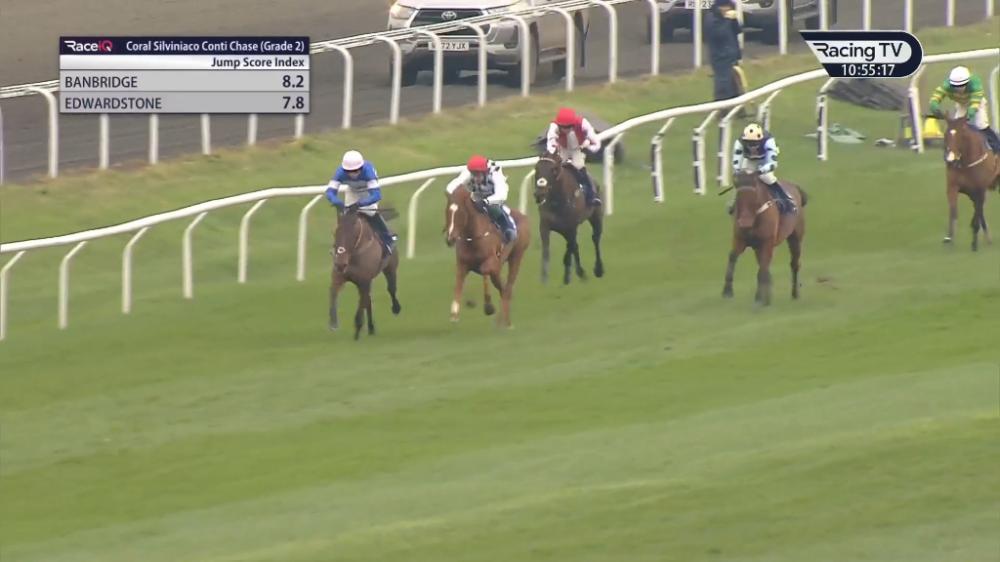
Angus McNae explains all you need to know about the Race iQ Jump Index, and draws on an illustrative example from the track
What is the RaceiQ Jump Index?
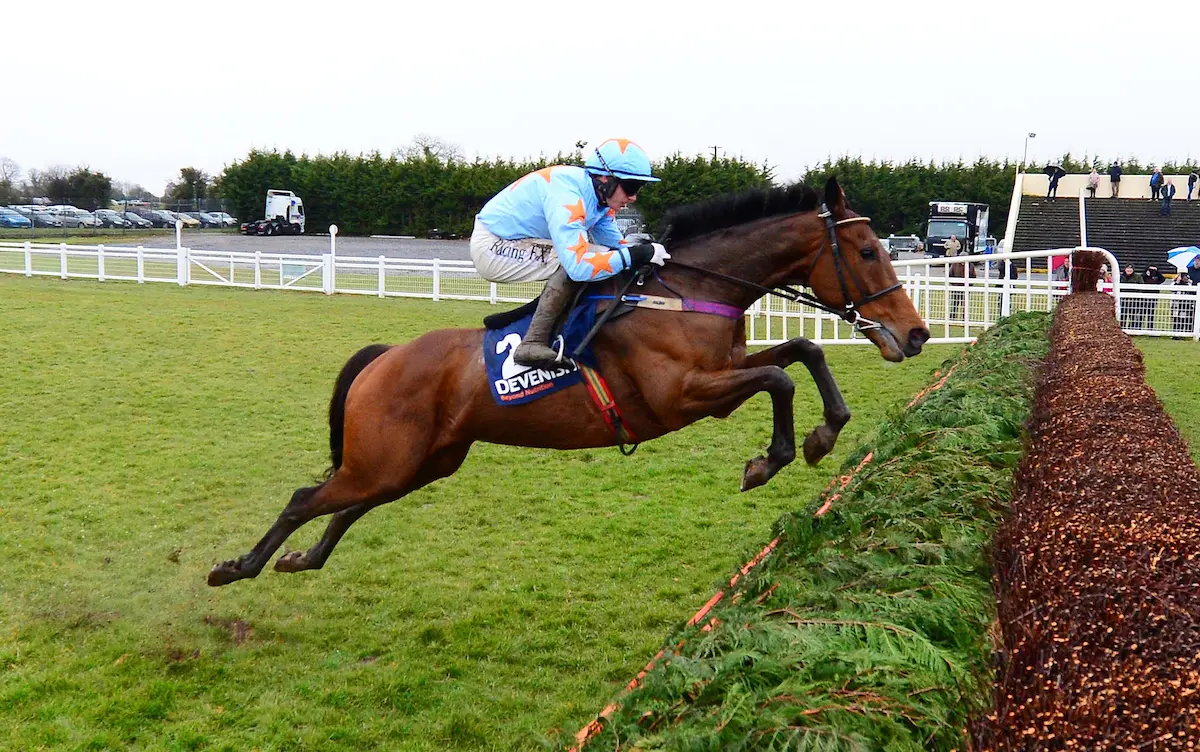
The RaceiQ Jump Index is a metric that quantifies a horse’s jumping ability at each obstacle, in a race, and throughout its career. It compares the efficiency, speed and fluency of a horse's jumps against all those recorded in the RaceiQ database.
What is the purpose of the Jump Index?
Unlike Lengths Gained Jumping (LGJ), the Jump Index assesses a horse’s jumping in its own right and without reference to the competition. The index produces a score out of ten reflecting how well the horse jumped at an obstacle or in a race. This figure allows us to compare the jumping abilities of horses that have never run against each other, independent of any differences in tracks, ground conditions, or race distances.
Building on Lengths Gained Jumping
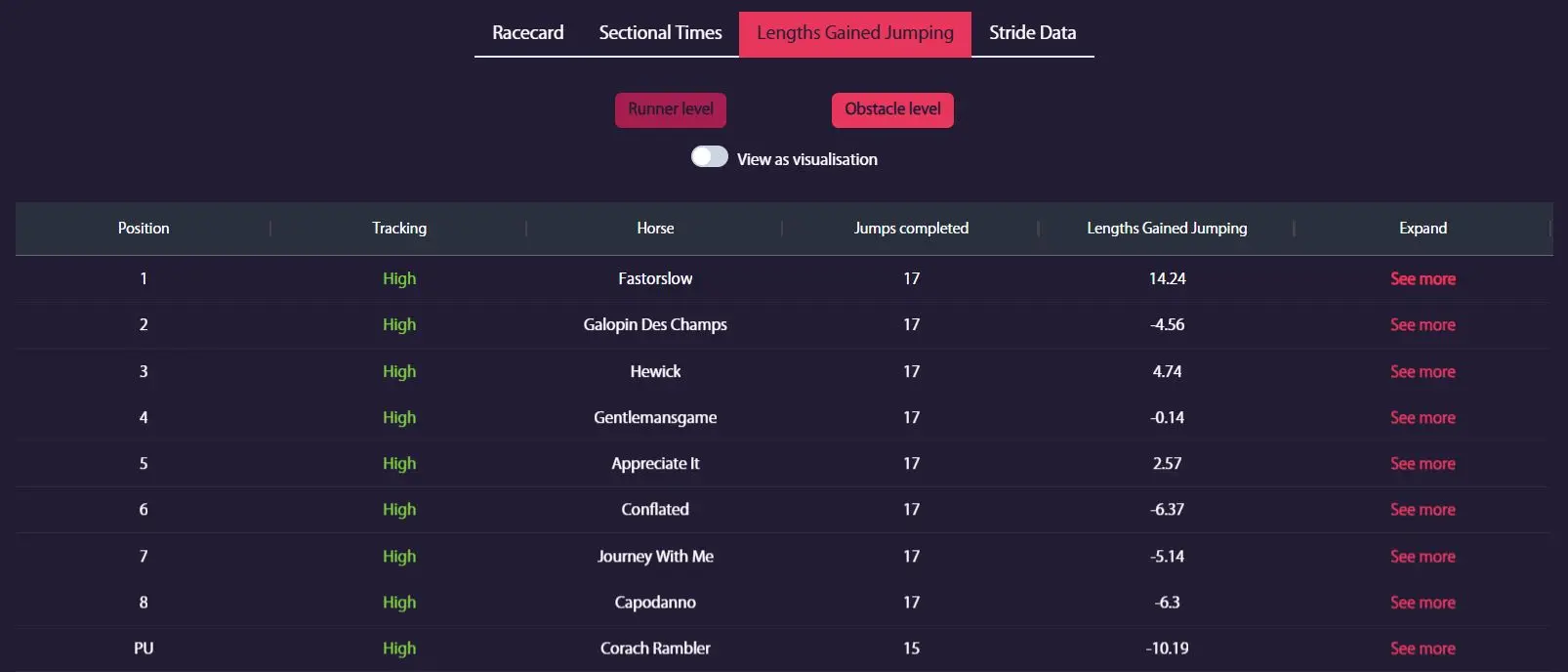
The 2024 Punchestown Gold Cup from the perspective of Lengths Gained Jumping
RaceiQ’s Lengths Gained Jumping (LGJ) metric is a groundbreaking tool for comparing the relative jumping performance of horses within a race. For example, it helps explain why Fastorslow beat Galopin Des Champs in the Punchestown Gold Cup 2024: he gained 19 lengths on Galopin Des Champs thanks to better jumping throughout the race.
Building on LGJ, the RaceiQ Jump Index quantifies the jumping ability of every horse with a score (out of 10). This score reflects the efficiency, speed and fluency of a horse’s jumping and enables us to directly compare performances across races.
To do this, RaceiQ has developed a model that compares a horse's detailed GPS tracking data over an obstacle against all jumps in the RaceiQ database. The model accounts for variables such as racecourse, going, race distance, and the different obstacles jumped. It then generates a score out of 10 for every obstacle and race, reflecting a horse’s performance independent of the competition. An average performance will achieve a score around a 7.
Based on the feedback from the experts we work with - and what the data itself has suggested - an effective jump is one where a horse retains more of its speed. It also suggests that it is more difficult for horses to retain speed when travelling faster. For this reason, the Jump Index model focuses mainly, but not exclusively, on the relationship between Speed Lost and Entry Speed.
An example: the John Durkan Chase
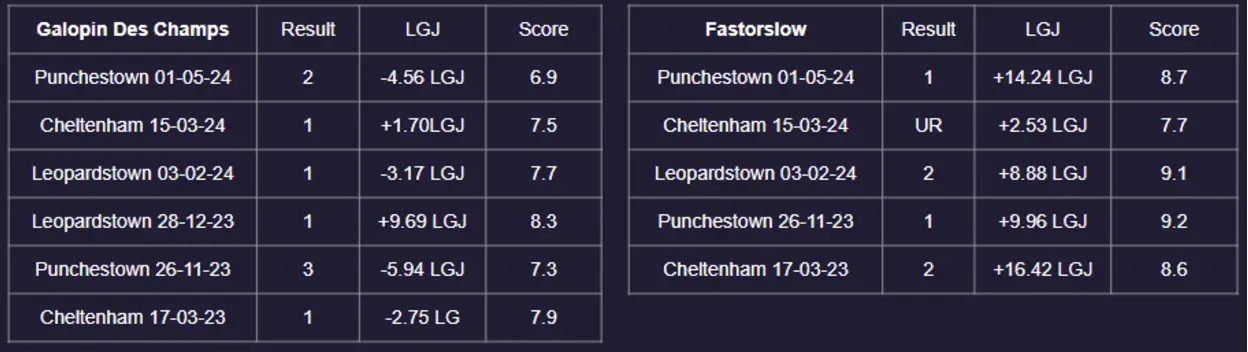
As an example, we are going to take a look at the comparison between Galopin Des Champ and Fastorslow before the John Durkan on Sunday.
Lengths gained jumping already tells us that Fastorslow jumped jumps far slicker than Galopin De Champs, something that is likely to have contributed to his two defeats of him last season.
As you can see, this is reflected in the Jump Indexes of both horses. Excluding the Cheltenham Gold Cup, where Fastorslow is penalised for his unseat, Fastorslow is far more efficient than Galopin Des Champ and therefore consistently ranks higher in terms of jumping.
When the emphasis is on jumping, Fastorslow holds a considerable advantage.
Over 2m4f on slightly better ground, Galopin De Champs jumping gives him far too much work to do in between fences. On heavy ground, where the emphasis is on stamina, and less on jumping, he then holds the upper hand.
This demonstrates how useful the Jump Index will be for horses that have not run against each other.
In this case we can use Lengths Gained Jumping to determine who the better jumper is. However, had they avoided each other, we could have used the Jump Index to highlight where Galopin De Champ’s weaknesses lay in comparison to Fastorslow, regardless of whether or not they had run against each other:
RaceIQ Jumps metrics in full
Find out more in the RaceiQ glossary:
Lengths Gained Jumping - The lengths gained by a horse at each obstacle in a race in comparison to the median of the field. A negative value indicates the horse lost lengths at the obstacle.
Entry speed - The speed (in mph) the horse was running at when it entered the Jumping Envelope.
Jumping Envelope - A section of the race which includes a steeplechase fence or hurdle. This section is defined as 30 metres before to 30 metres after a horse has landed from jumping over an obstacle.
Speed lost - The difference in a horse’s speed (in mph) from entering the Jumping Envelope to landing after jumping the obstacle.

Related posts
Under The Radar: Paddy Magee nominates three to follow
Ross Millar's Monday tips: "he is undeniably well handicapped"
Bond Thoroughbreds: the inside track on their top team
Trustyourinstinct flies home to land Curragh Cup
William Buick set to be reunited with Touleen at Ascot
Featured offers

Bet £10 get £40 in free bets with Kwiff
T&Cs Apply
Claim Now

Bet £10 Get £40 in free bets + Money back 2nd to SP fav with BOYLE Sports
T&Cs Apply
Claim Now

Bet £10 get £30 in Free Bets with TalkSportBet
T&Cs Apply
Claim Now

Get a £50 free bet when you bet £50 with Coral
T&Cs Apply
Claim Now

Bet £10 get £30 in Free Bets with BallyBet
T&Cs Apply
Claim Now
Copyright 2026 Racing TV - All Rights Reserved.
Please bet responsibly
Copyright 2026. All rights reserved