Login
WATCH FREE
An introduction to Speed Lost
Introduction to Speed Lost, by Page Fuller, RaceiQ Editorial Analyst
For those who have watched one of Racing TV's Road To Cheltenham shows, you will have noticed us using a couple of our derived metrics to dig into horses’ ‘Length’s Gained Jumping’ performances. In particular, we have been talking a lot about ‘Speed Lost’ a lot so I wanted to take this opportunity to explain it a little further:
We measure speed lost by comparing a horse’s speed when it lands, with the speed it was travelling at entering the ‘jumping envelope’. This is defined as 30m either side of the jump, for those of you who haven’t read my Lengths Gained Jumping explainer. From this, we can help work out why a horse may have underperformed at each fence.
Take the 2023 John Durkan Chase as an example:
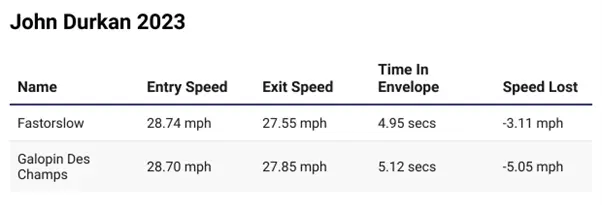
Throughout this race, we saw with our Lengths Gained Jumping model, that Fastorslow gained a 9.86 length advantage in total on the field through his jumping. Galopin Des Champs on the other hand lost 5.94 lengths in total on the field through his jumping. This begs the question, where did it all go wrong?
By looking deeper into our derived metrics (the metrics that feed into the Lengths Gained Jumping model) we can see that the main difference between the two was the speed lost over their jumps:
The above table shows the average values recorded by both Fastorslow and Galopin Des Champs throughout the race. You can see that even though both approached the fences on average at the same pace, Galopin Des Champs on average lost 1.94 mph more than Fastorslow to the point of landing. This is a big difference!
What is also interesting is that the average time spent in the jumping envelope for both of them are fairly similar too. You can see this is because Galopin Des Champs is having to go faster out of the jumping envelope (0.30mph) to make up for the speed he lost.
So why is this infomation useful? Well if you can imagine your driving your car down the motorway and hit traffic, how much more fuel are you using when you’re constantly having to speed up and slow down? The more you have to accelerate after you slow down, the quicker you run out of fuel.
How much extra energy is Galopin Des Champs having to use to make up that 5.05mph he lost than Fastorslow is to make up 3.11mph. So yes, we can say he lost 15 lengths on Fastorslow through his jumping inefficiency, but underneath we can assume that his extra energy expenditure must also have played a part.
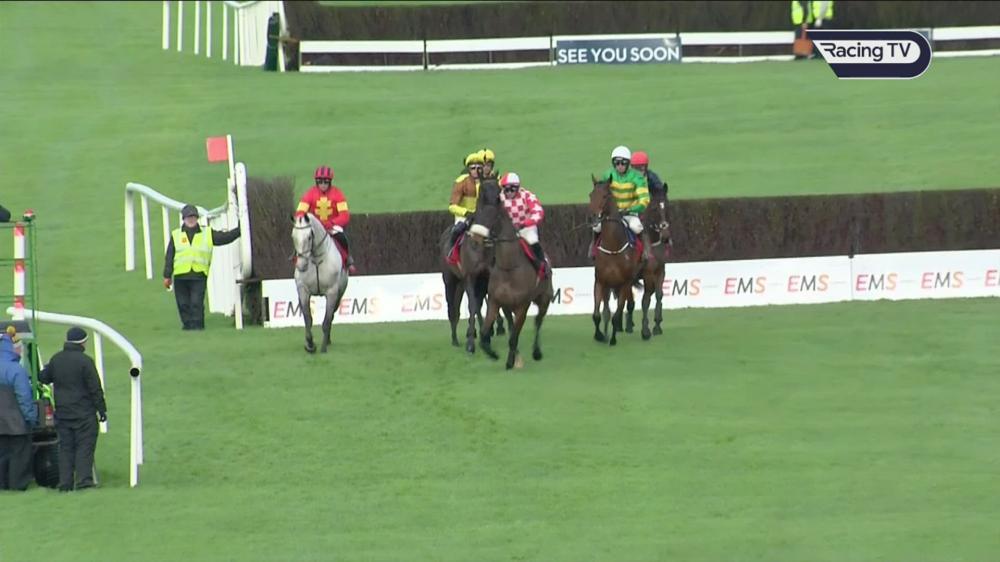
Watch the full replay of Galopin Des Champs' success - and how he had to work harder to get back up to speed at each fence
Copyright 2026 Racing TV - All Rights Reserved.
Please bet responsibly
Copyright 2026. All rights reserved