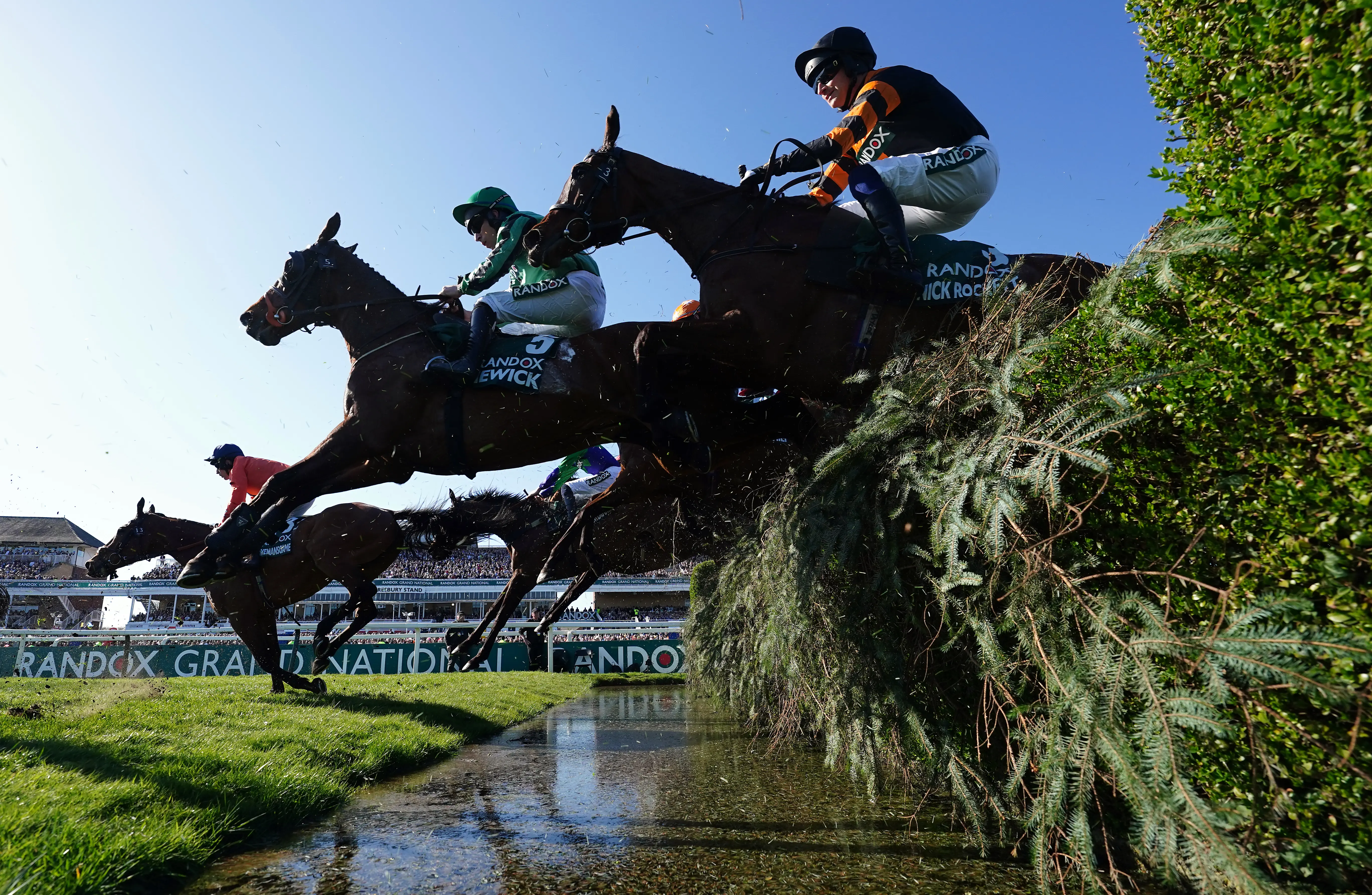
The Grand National has changed but good jumpers are still rewarded

By Andy Stephens
Last Updated: Sat 11 Apr 2026
The nature of the Randox Grand National has changed in recent years but the RaceiQ data confirms that the two great pillars of the race, jumping prowess and staying power, remains crucial.
Modifications in recent years have included the drop landings being levelled out and the wooden cores to the fences being replaced with plastic versions, making them much more forgiving. In addition, fewer runners are now allowed to take part, and the race distance has been shortened.
These changes have led to a higher calibre of horse taking part. For instance, the first three home last year had official handicap ratings of between 163 and 167, with the lowest rated runner being 145.
Just ten years ago, 20 horses rated below 145 were in the line-up, while a decade before that there had been 28, with 21 of those having a mark in the 130s. Such a horse these days would have next to no chance of making the cut.
Some fans of the sport now question whether jumping ability has the same bearing as in yesteryear. Let’s explore the thinking.
Since Aintree has gone “plastic” in 2013, there have been a dozen renewals and 204 of the 461 runners have completed (44.25%). There have been 52 fallers (11.27%) and 62 unseated riders (13.44%). Not one runner fell in the 2024 renewal.
Compare that to the 12 editions of the race immediately beforehand. In those, there were 163 finishers from 479 runners (34.02%), and there were 113 fallers (23.59%) and 88 unseats (18.37).
So, there has been a 10% increase in horses completing the course, while fallers have more than halved. When the race and the sport is under so much scrutiny, that is a massive positive.
And reassuringly, RaceiQ’s numbers tell us that horses who are nimble on their feet and swift to get from A to B, like so many of the great winners from years gone by, are still handsomely rewarded.
Last year’s edition provided a vivid example.
How Nick Rockett took off
Nick Rockett, trained by Willie Mullins and ridden by his son, Patrick, fended off I Am Maximus and Grangeclare West in a pulsating finish. Just three lengths separated the stablemates after more than nine minutes of frenetic action, with Iroko and Meetingofthewaters not far behind in fourth and fifth.
RaceiQ provides in-depth analysis for the performance of every horse and their data confirms emphatically that Nick Rockett’s fast and economical jumping was essential in him joining the race’s rich roll of honour.
He gained 20.63 lengths with a masterclass in how to jump at the course nowadays, whereas I Am Maximus, the runner-up, lost 6.69 lengths. That swing of more than 27 lengths made all the difference, and then some.
The next six horses home also jumped well, gaining between 8.36 lengths and 17.77 lengths, but none were as efficient as Nick Rockett.
Had all last year’s runners jumped the same, then the outcome would have been completely different. I Am Maximus would have triumphed by more than 15 lengths; Grangeclare West would have been second, with Iroko third and Meetingofthewaters sneaking into fourth.
Nick Rockett? He’d have been only fifth.
The 30 spruce fences were his friend, and he got an overall Jump Index score of 8.4 out of 10 for his efficiency.
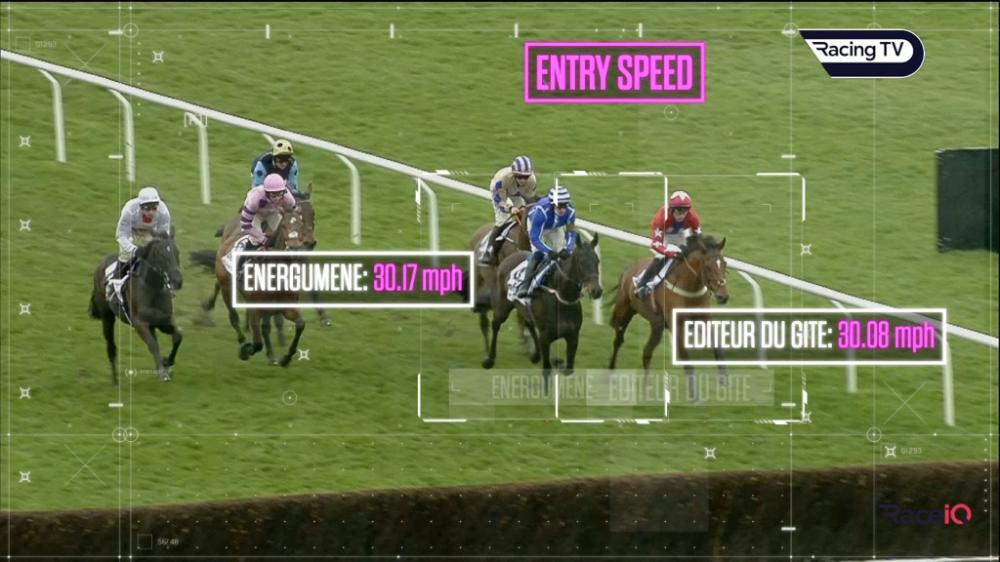
Nick Rockett lost an average of just 4.03mph over each of the obstacles and gained ground over 24, jumping best of all at four of them, including the first, which he attacked at 33.4mph.
We can see that his average entry speed at every fence was 28.72mph (second best); that his Speed Recovery Time was just 1.02sec (third best); and that he spent an average of 5.04sec in the Jumping Envelope, 30 metres before and after each fence (second best).
In summary, he didn’t hang around.
We can dig even deeper. He reserved his most efficient leap for the 12th, where he got a score of 9.1. He also got an 8.7 when jumping it on the second circuit, three out, and did not get anything lower than a 6.9 all the way around.
Nick Rockett was easy on the eye as he glided around Aintree, although RaceiQ gives no extra marks for artistic impression. The data is only interested in one thing: speed. And on multiple levels.
RaceiQ was founded three years ago and uses GPS tracking data to assess how horses travel through each section of a race.
Each tracker collects the location of each horse at a rate of 18 GPS data points per second. This paints a full picture of a horse’s movements. With more than 50 metrics modelled by Data Scientists, using AI and eight billion datapoints, it is revolutionising analysis in racing, helping us understand exactly what is happening before our eyes.
Each horse gets a score out of 10 for every individual fence negotiated; plus an overall score out of 10 for jumping in every race. In turn, horses also get a rolling career Jump Index score out of 10.

A delve into 16 races over the Grand National fences
Only five races take place on the Grand National fences every year, and RaceiQ has 15 contests in its database to assess for possible patterns or clues (this includes the Foxhunters' and Topham this week).
That’s a small pool, over a variety of distances on a range of ground, but we can make it a bit bigger by looking at the first four horses home each time.
The 16 winners of those races were awarded Jump Index scores on the day ranging between 7.1 and 8.9. The average has been about 7.8, and it's been similar for the second, third and fourth home.
Of the 64 horses who fell under our gaze, 11 got a Jump score of under 7, and none of them won.
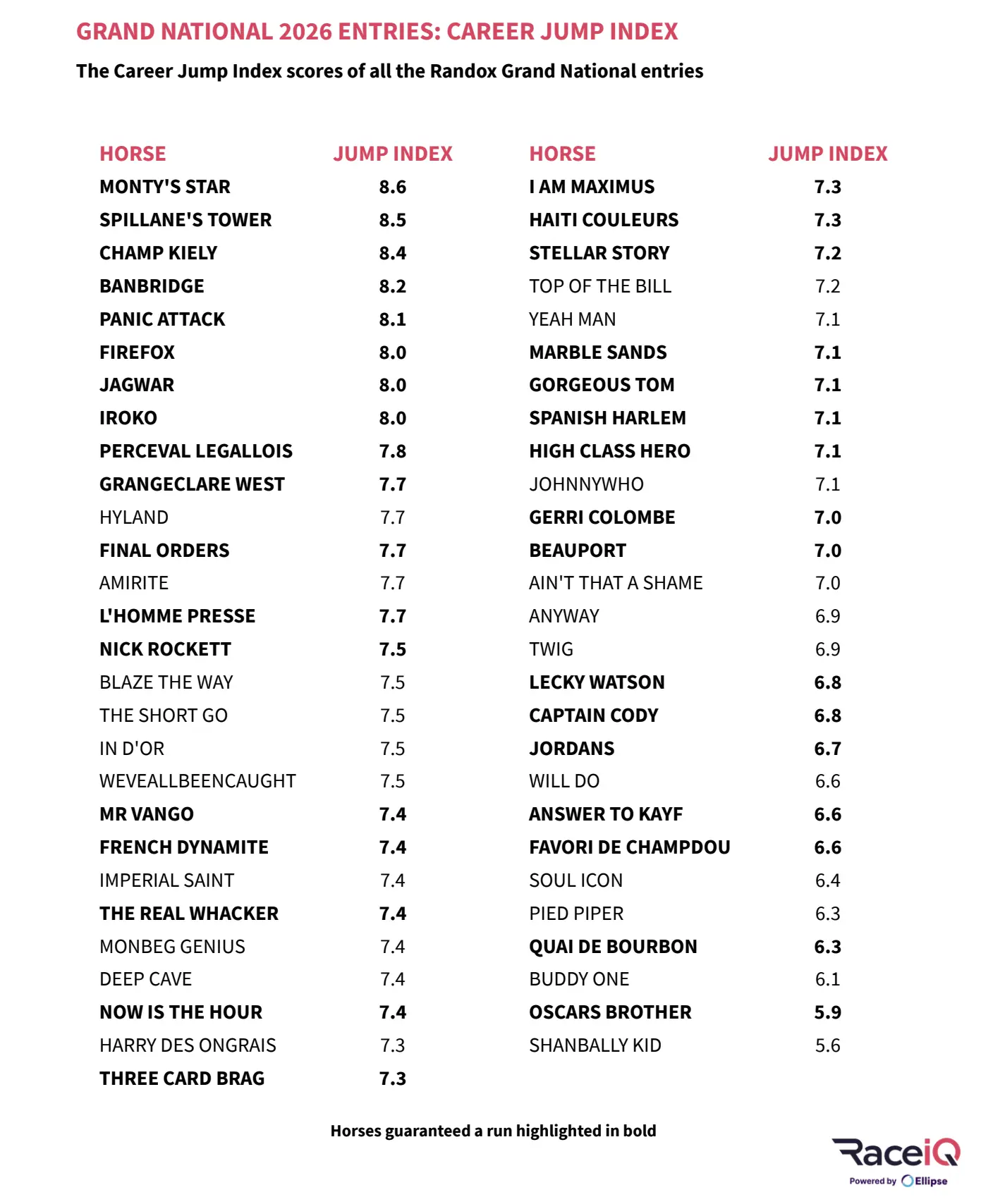
The Jump Index scores of all Saturday's possible runners
As a rule, anything lower than 6 out of 10 is below average. Between 6 and 6.9 is low to middle of the road; 7 to 7.7 is usually efficient to bordering on handy. Anything above that and you have a very decent jumper on your hands who, invariably, will be stealing lengths in the air.
There are 4,990 horses with a Career Jump Index over fences in the RaceiQ database.
Only eight have a Career Jump Index score of 8.6 or higher; another 68 have a rating between 8.1 or higher; and a further 386 have a score of 7.6 or higher. This group make up the top 9.21% of jumpers.
With Saturday’s big race in mind, it is perhaps worth paying extra attention to those runners whose Career Jump Index score is 7.6 or higher, as it gives them a solid starting base.
By contrast, those whose rating is 7 or under may have to do things the hard way, while accepting there are always exceptions to every rule and that they may jump better than they have done in the past.
Incidentally, the 14 winners have between them gained about 127 lengths with their jumping (an average of about nine each). The horses to finish second have swiped about 83, with the thirds on 62 and the fourths grabbing 91.
Strong finishers
Of course, jumping is only one of the attributes required to win a Grand National.
Stamina is crucial, as it’s no good being the best jumper in the world if you run out of petrol before the finish line. Speed is required, too, to hold a position, while some courage and a bit of good fortune also come in handy.
Few of the runners are proven over four-and-a-quarter miles, and the data cannot give us definitive answers as to who will have the ability to sustain a strong gallop over such a distance.
However, Finishing Speed Percentages (FSP) can offer a clue, as they measure how fast a horse runs its final half mile (at least over Jumps) compared to its average speed over the entire race.
An FSP of more than 100% means the horse is accelerating or finishing strongly, while below 100% indicates it is slowing down. Those consistently strong in the final stages are dropping a hint that they still have more in their locker and may stay further, especially if able to do that in truly run races.
For instance, Jagwar will be having his first race beyond 3m 1f on Saturday. Nobody can be certain he will stay, but his supporters can glean some encouragement from the fact that he has had the highest Finishing Speed Percentage in seven of his eight races over fences. He’s also had the fastest final furlong in five of those contests.
Stride patterns worth a second look
Enjoy The Formbook with Danny Archer and Dan Overall
Another factor which is often overlooked is the stride data of the runners, which RaceiQ also records. Once established, there are only minor variations from race to race, depending on the topography of the track and ground conditions.
The elite sprinters in racing, on the Flat, generate their pace by generally turning over 2.5 strides per second or more.
By contrast, stayers are more conservative and their strides per second are much lower. The past four winners of the Cheltenham Gold Cup, for example, have turned over their strides at between 1.98 and 2.05 per second.
And the past three Grand National winners have also averaged 2.05 strides per second. A low cadence can be beneficial, although it is probably a handier tool when assessing the potential stamina requirements/limitations of young Flat horses.
Finally, there is a natural assumption that most winners clock the Top Speed in a race, but that is often not the case.
Seven other runners in last year’s National managed a Top Speed higher that Nick Rockett, but none finished better than sixth. The winner’s speed was spread tremendously efficiently, with nothing quicker than him over the final half mile.
And a final thought regards the predictability of the race. Despite the alterations, it remains an extremely tough puzzle with the average winning SP in the past decade being 20-1, and the average price of the placed horses being 25-1.
Good luck if you are having a flutter.

Related posts
Five horses to watch at Cheltenham this week
Dave Nevison's Wednesday tips at Kempton: "he looks very well in"
Saturday ante-post tips: brace of 20-1 chances among five bets
Philip Hobbs and Johnson White 2026-27 Jumps season stable tour
Five changes made at Cheltenham ahead of the 2026-27 season
Todays top offer

Bet £10 Get £30 in Free Bets + Money Back as a Free Bet if 2nd to SP Fav with BOYLE Sports
T&Cs Apply
18+. New UK customers (Excluding NI) only. Min Deposit £10. Min stake £10. Min odds Evs. Free bet applied on 1st settlement of any qualifying bet. 30 days to qualify. Free bets expire in 7 days. Cashed out/Free Bets won’t apply. Account & Payment method restrictions apply. 1 Free Bet offer per customer, household & IP Address only. T&C's apply. 18+. IRE/NI & UK online only. Max Free Bet £/€10. Win or win part of e/w outright singles. 5+ runners. 1st bet on each race. Free/void/antepost bets don't qualify. In event of a dead heat, offer won’t apply. Applies to First Past the Post result. Unnamed 2nd Favs don’t qualify. Acc & Payment restrictions apply. T&Cs apply.
Claim Now
Featured offers

Bet £10 get £30 in Free Bets with talkSPORT BET
T&Cs Apply
Claim Now
New Customers. Opt in, deposit and bet £10+ on any horse racing markets within 7 days of sign up. Get 3 x £10 Free Bets for set horse racing markets. Bonuses expire in 7 days. T&Cs apply. Please gamble responsibly. 18+ GambleAware

Bet £20 and Get £40 in Free Bets with Unibet
T&Cs Apply
Claim Now
18+. GambleAware.org. New GB customers only. Min £20 debit card or instant banking transfer deposit. Place a £20+ bet on Horse Racing at min odds 2/5 (1.4) each leg for 4x £10 Free Bets (can be used on Racing Bet Builder). Claim within 30 days. Valid for Horse Racing only. Geographical restrictions and Further T&C’s apply

Get 50% back up to £50 with QuinnBet
T&Cs Apply
Claim Now
New UK Customers Only. Bet £10+ on any sportsbook markets at odds of evens (2.00) or greater. Get 50% back of your first day’s losses as a Free Bet up to £50, valid for 7 days. 18+ GambleAware.

Bet £10 get £40 in free bets with Kwiff
T&Cs Apply
Claim Now
New UK customers. Place a £10 real money bet at min. 2.0 odds within 5 days of deposit. Get 4 x £10 Free Bets: 1 Single, 2 Accas & 1 Bet Builder (min. 3 selections each). Excludes cashout, E/W, Multis, Ineligible Markets & Odds Boosts. Credited after bet settlement. 7-day expiry. T&Cs apply. 18+ GambleAware
Copyright 2026 Racing TV - All Rights Reserved.
Please bet responsibly
Copyright 2026. All rights reserved