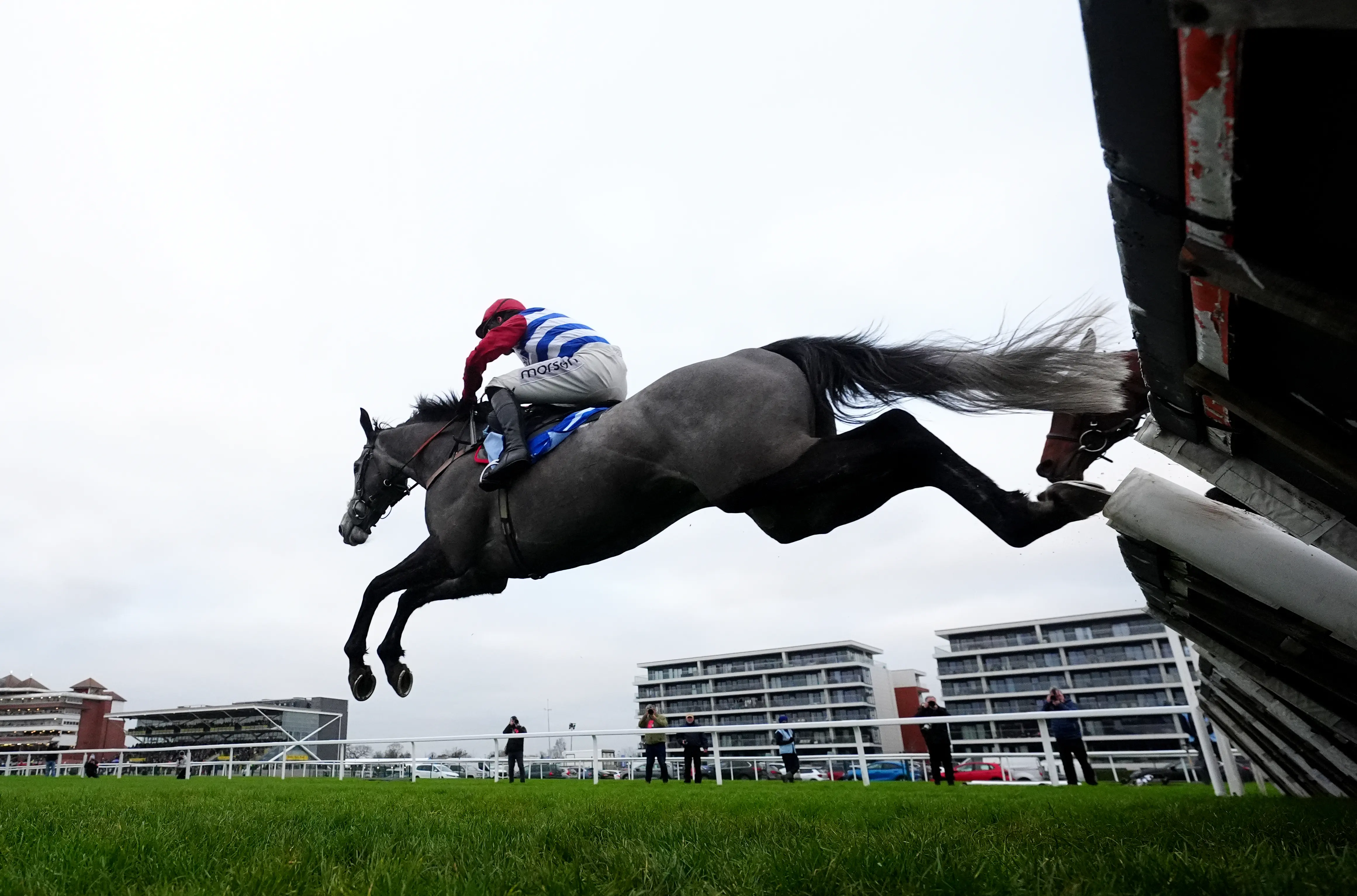
Cheltenham Festival: RaceiQ's essential clues for day two

By Andy Stephens
Last Updated: Tue 10 Mar 2026
We need all the help we can get to solve the seven daily puzzles at The Festival, so Andy Stephens looks at what the data tells us for Wednesday's action.

✅ NO DRAMA THIS END
1.20 Turners Novices’ Hurdle (Grade 1)
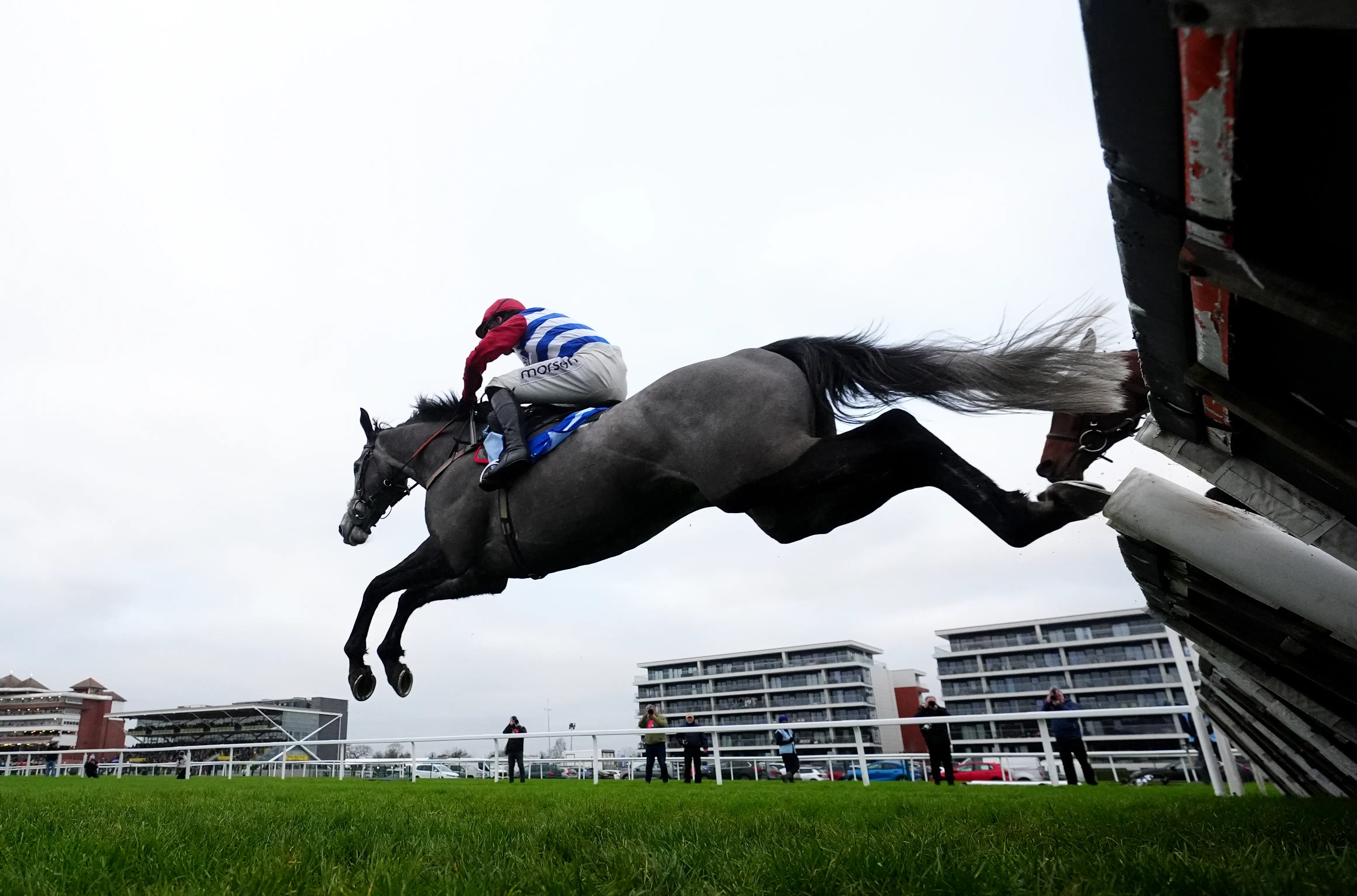
The dashing grey has won each of his three races over hurdles, with his jumping being exemplary by any standards, let alone for a novice.
He got a Jump Index score of 8.1 out of 10 when winning over course and distance in November; was awarded an 8.4 next time at Sandown and then got a whopping 9.1 in the Challow at Newbury.
None of the leading players in the field has attacked a hurdle quicker than him (35.44mph) or matched his Top Speed of 36.41mph. His final half-mile time of 51.81sec is the second fastest final half mile over obstacles at Newbury in the RaceiQ database from 1,286 runners.
There was no data for his recent gallop with stablemate Tutti Quanti at Kempton but the broad smile of Paul Nicholls afterwards also warranted a 10/10.
❌ OSCARS BROTHER
2.00 Brown Advisory Novices’ Chase (Grade 1)
Oscars Brother is a leading fancy for the Brown Advisory Novices' Chase after winning his past three races,but he is surely going to have to jump better to make an impact at the highest grade.
His past three Jump Index scores have been 5.2, 7 and 4.9. He’s surrendered about 23 lengths with his jumping in those contests.
✅ MAJBOROUGH
4.00 BetMGM Queen Mother Champion Chase (Grade 1)
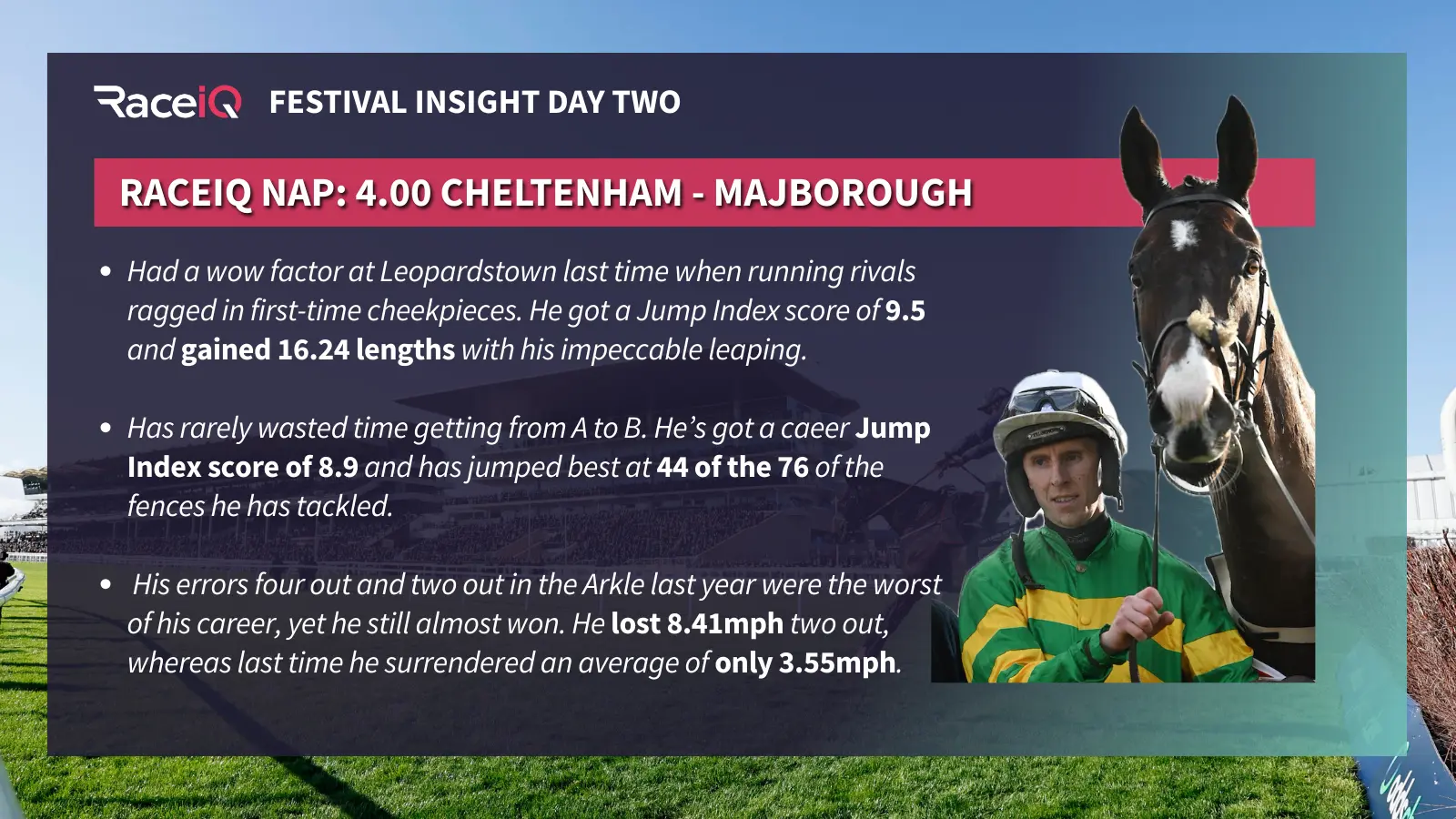
Majborough got a Jump Index score of 9.5 and gained 16.24 lengths with his impeccable leaping when running his rivals ragged in first-time cheekpieces in the Dublin Chase at Leopardstown last time.
The data tells us that he’s always been swift at getting from A to B over fences, regardless of him throwing in the odd scruffy leap. Unlike in gymnastics, diving or ice skating, RaceiQ does not give marks for artistic impression. A horse could jump over a fence backwards and it would not matter.
Majborough’s career Jump Index score is a glowing 8.9 out of 10 and is based around a tremendous amount of science. Using your eyes is essential when assessing the form, but the data fills in gaps that are impossible to see.
The RaceiQ metrics are built off detailed GPS tracking data that is collected by two trackers on each horse at a rate of 18 data points per second.
This tells us the time a horse spends in the Jumping Envelope (30 metres before and after the fence); Entry Speed; Exit Speed; Speed Recovery Time (how long it takes the horse after landing from a jump to reach the post-jump average speed of the field); and Speed Lost (the difference in a horse’s speed from entering the Jumping Envelope to landing after jumping a fence).
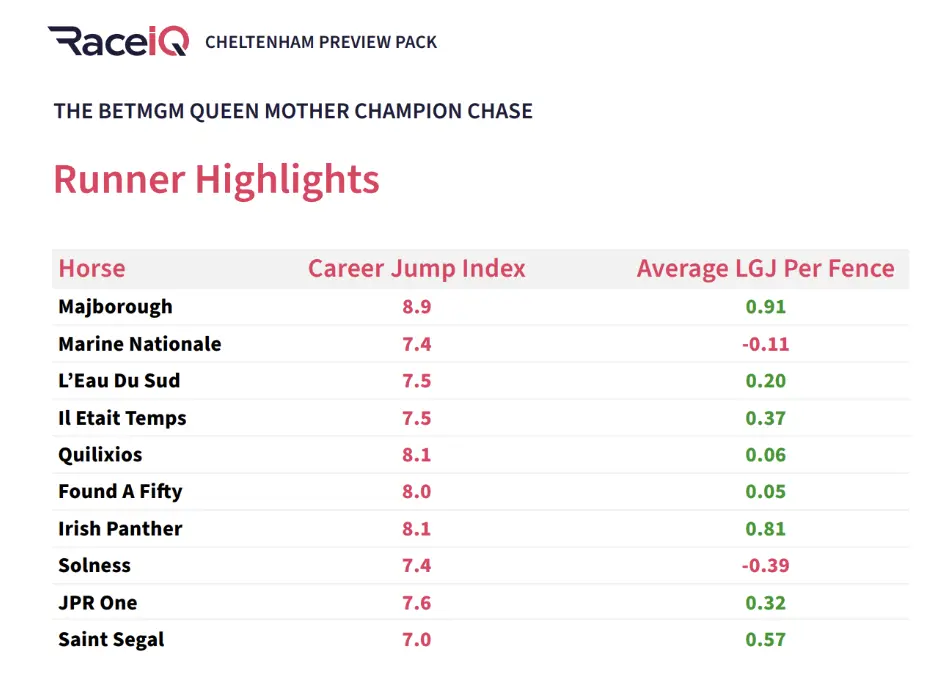
Lengths Gained Jumping reveals the lengths gained (or lost) by a horse throughout the Jumping Envelope, while Cumulative Lengths Gained reflects a rolling summation of the lengths gained across all obstacles. The Jump Index is a score, out of 10, quantifying the efficiency, speed and fluency of the horse’s jump over each obstacle.
The shortcut, then, is the overall Jump Index score, which puts all the metrics under one umbrella. Majborough’s seven individual scores in his chase races have been 9.0, 9.6, 7.8, 7.9, 9, 9.1 and 9.5. That’s gold medal territory.
Majborough has jumped best of the whole field at no fewer than 44 of the 76 of the fences he has tackled. In other words, he’s been quickest to navigate the Jumping Envelope almost 58% of the time, whereas his 38 rivals have collectively been swiftest about 42%.
He has gained ground with his jumping in all his races over fences, with his accumulative gain being about 58 lengths. The bad news for him is that only a smidgeon of that came in the Arkle last year.
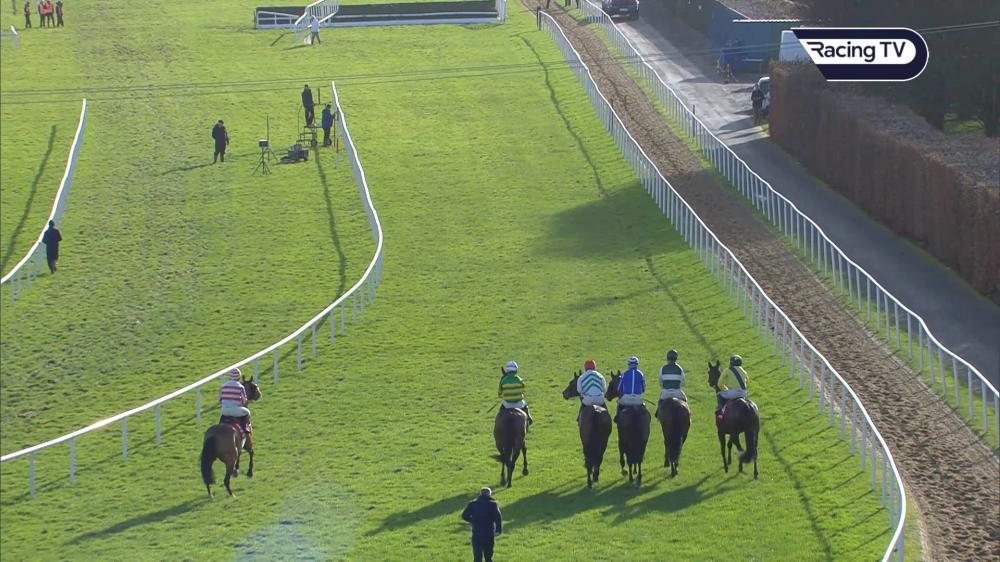
His errors at the second fence and two out in that contest were the worst of his career (they merited scores of 6.2 and 5.6), yet he still almost won. He lost more than 6mph each time, whereas last time he surrendered an average of only 3.55mph at each fence.
The question he has got to answer is whether those errors were a Cheltenham one-off, a case of wrong time at the wrong place. He’s odds-on after the defection of Marine Nationale.
His supporters should take encouragement from the fact that he jumped well at most of the fences, and that he swiped seven lengths when landing the Triumph Hurdle 12 months earlier. It would certainly be premature to suggest the challenges of the track are beyond him.

Related posts
Five horses to watch at Cheltenham this week
Dave Nevison's Wednesday tips at Kempton: "he looks very well in"
Saturday ante-post tips: brace of 20-1 chances among five bets
Philip Hobbs and Johnson White 2026-27 Jumps season stable tour
Five changes made at Cheltenham ahead of the 2026-27 season
Todays top offer

Bet £10 Get £30 in Free Bets + Money Back as a Free Bet if 2nd to SP Fav with BOYLE Sports
T&Cs Apply
18+. New UK customers (Excluding NI) only. Min Deposit £10. Min stake £10. Min odds Evs. Free bet applied on 1st settlement of any qualifying bet. 30 days to qualify. Free bets expire in 7 days. Cashed out/Free Bets won’t apply. Account & Payment method restrictions apply. 1 Free Bet offer per customer, household & IP Address only. T&C's apply. 18+. IRE/NI & UK online only. Max Free Bet £/€10. Win or win part of e/w outright singles. 5+ runners. 1st bet on each race. Free/void/antepost bets don't qualify. In event of a dead heat, offer won’t apply. Applies to First Past the Post result. Unnamed 2nd Favs don’t qualify. Acc & Payment restrictions apply. T&Cs apply.
Claim Now
Featured offers

Bet £10 get £30 in Free Bets with talkSPORT BET
T&Cs Apply
Claim Now
New Customers. Opt in, deposit and bet £10+ on any horse racing markets within 7 days of sign up. Get 3 x £10 Free Bets for set horse racing markets. Bonuses expire in 7 days. T&Cs apply. Please gamble responsibly. 18+ GambleAware

Get 50% back up to £50 with QuinnBet
T&Cs Apply
Claim Now
New UK Customers Only. Bet £10+ on any sportsbook markets at odds of evens (2.00) or greater. Get 50% back of your first day’s losses as a Free Bet up to £50, valid for 7 days. 18+ GambleAware.

Bet £20 and Get £40 in Free Bets with Unibet
T&Cs Apply
Claim Now
18+. GambleAware.org. New GB customers only. Min £20 debit card or instant banking transfer deposit. Place a £20+ bet on Horse Racing at min odds 2/5 (1.4) each leg for 4x £10 Free Bets (can be used on Racing Bet Builder). Claim within 30 days. Valid for Horse Racing only. Geographical restrictions and Further T&C’s apply

Bet £10 get £40 in free bets with Kwiff
T&Cs Apply
Claim Now
New UK customers. Place a £10 real money bet at min. 2.0 odds within 5 days of deposit. Get 4 x £10 Free Bets: 1 Single, 2 Accas & 1 Bet Builder (min. 3 selections each). Excludes cashout, E/W, Multis, Ineligible Markets & Odds Boosts. Credited after bet settlement. 7-day expiry. T&Cs apply. 18+ GambleAware
Copyright 2026 Racing TV - All Rights Reserved.
Please bet responsibly
Copyright 2026. All rights reserved