Login
WATCH FREE
Introducing the RaceiQ Par Sectionals and FSP
Hopefully you are now familiar with our RaceiQ Par Time and Time Index models that have been used on RacingTV. As mentioned previously, those models are designed to contextualise a horse’s performance on the clock based on previous time performances under specific race conditions.
Using these times we have a benchmark of how fast a horse is expected to run from ‘A’ to ‘B’, but horses can achieve that time in many different ways.
In Britain and Ireland we are fortunate enough to have some very unique tracks, each with many different topographies and nuances. For this reason, comparing the sectional times across different courses at certain points in the race becomes very difficult, even within one race itself. For sprints on a track like Leicester, the fastest furlong of a race is likely to be run at the start of the race when they’re running downhill. So how can we determine if they have finished ‘fast’ or ‘slow’ when the uphill finish means that they are unlikely to be able to quicken as they go up the hill?
We hope our Par Sectionals will help with this. Using them we can compare a horse's sectionals against the 'optimum' sectional times. These are based on the sectionals that winning horses have achieved in races achieving the best Time Index scores. Based on advice from experts we work with, the best race times will be achieved by horses running most efficiently.
When we compare these sectionals to ‘Par’ we then provide thresholds to split into the following:
•
Very Slow
•
Slow
•
Par
•
Fast
•
Very Fast
Therefore unlocking context into whether a horse has run ‘evenly’ (in line with Par) or inefficiently through a race.
Using these we can also contextualise the Finishing Speed Percentage (FSP) of a race, relative to the track it is run on and produce a Par FSP. For example, the six furlong track at Epsom has a Par FSP of around 103%, but the 1m4f course, which starts stiffly uphill, has a Par of around 112% as they are likely to run ‘steadily’ to start.
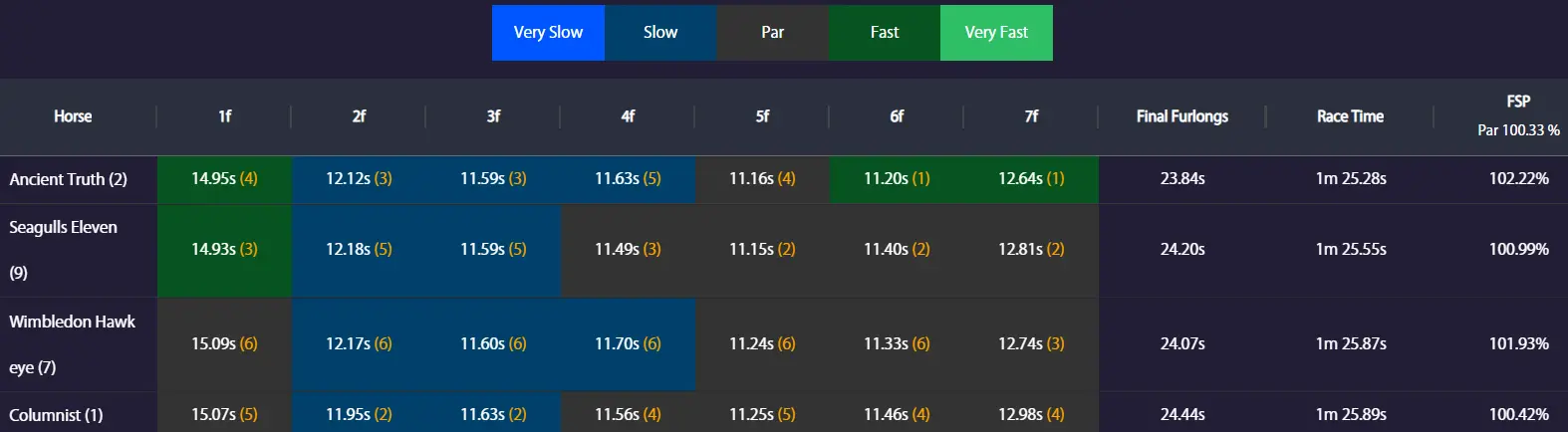
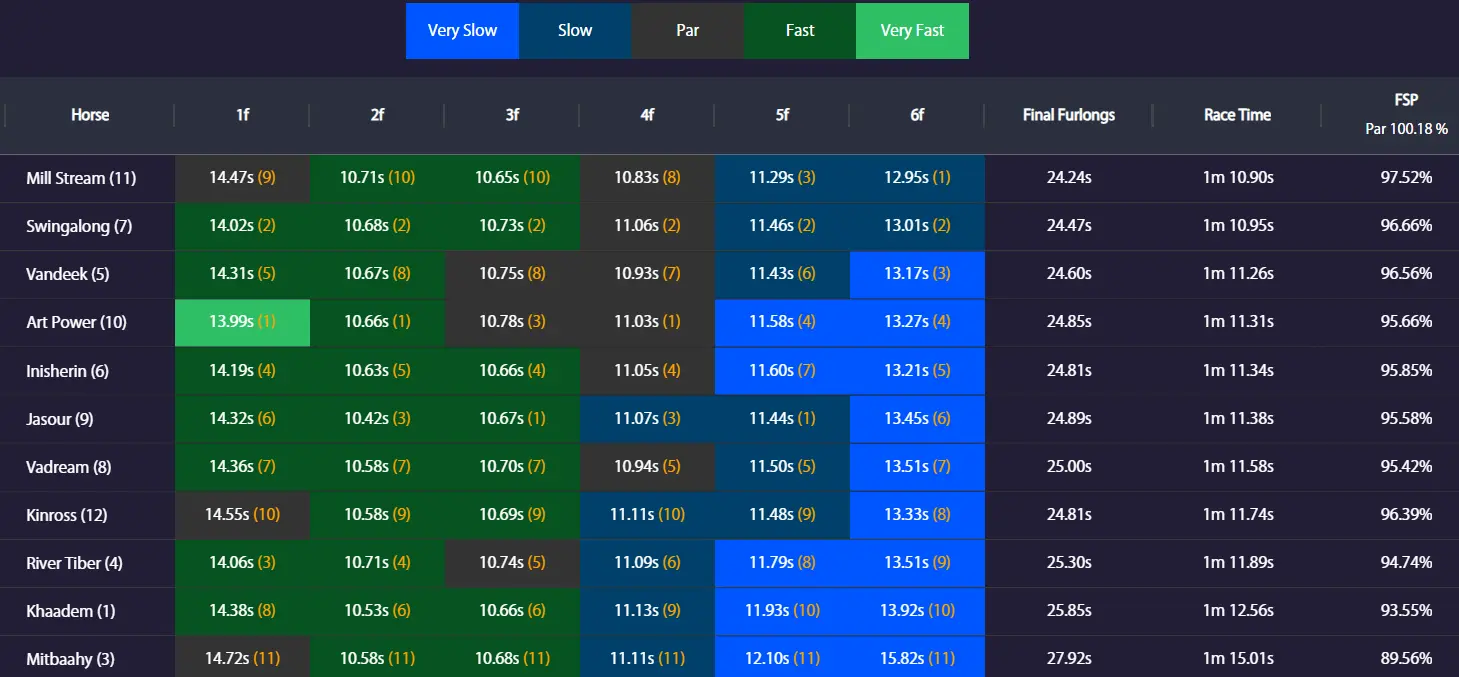
To illustrate these two products I will use the Par Sectionals from The Superlative Stakes at Newmarket and the July Cup. As you can see below, they were run in the complete opposite way;
In the Superlative, they went quite steady, and then Ancient Truth was the horse that was able to quicken up at the end. He also finished 'fast' as his FSP was higher than Par:
In the July Cup, Art Power went flat out to start with so they went fast to begin and then finished ‘slow’ with Mill Stream staying on the best at the end:
Copyright 2026 Racing TV - All Rights Reserved.
Please bet responsibly
Copyright 2026. All rights reserved