Login
WATCH FREE
RaceiQ: the Benvenuto Cellini uproar and what the data reveals

By Andy Stephens
Last Updated: Tue 9 Jun 2026
The debate over Benvenuto Cellini being declared a non-runner in the Derby shows no sign of slowing. A race that took just over two and a half minutes to run is still the hottest topic in town two and a half days later.
A horse called Christmas Day won the great race and, at this rate, we will still be talking about what occurred come December 25.
The British Horseracing Authority are certainly being robust in defending one of the most controversial stewarding decisions the sport has seen. I don’t know what the multiple of doubling down is, but they are providing an example of it.
Racing’s regulatory body have provided interviews galore, published a blog, produced a podcast and reeled off nine successive tweets on the subject.
Harry Angel keeps getting mentioned a lot.
The crack sprinter triggered the rule change about horses being “materially affected” after getting his hind leg stuck in the stalls at the start of the 2018 Diamond Jubilee Stakes, over six furlongs at Royal Ascot.
“He was stood like a dog with his leg up," trainer Clive Cox said at the time. Harry Angel stumbled out of the stalls and his race was over before it had started. He suffered a puncture wound, too, and did not run for another 77 days.
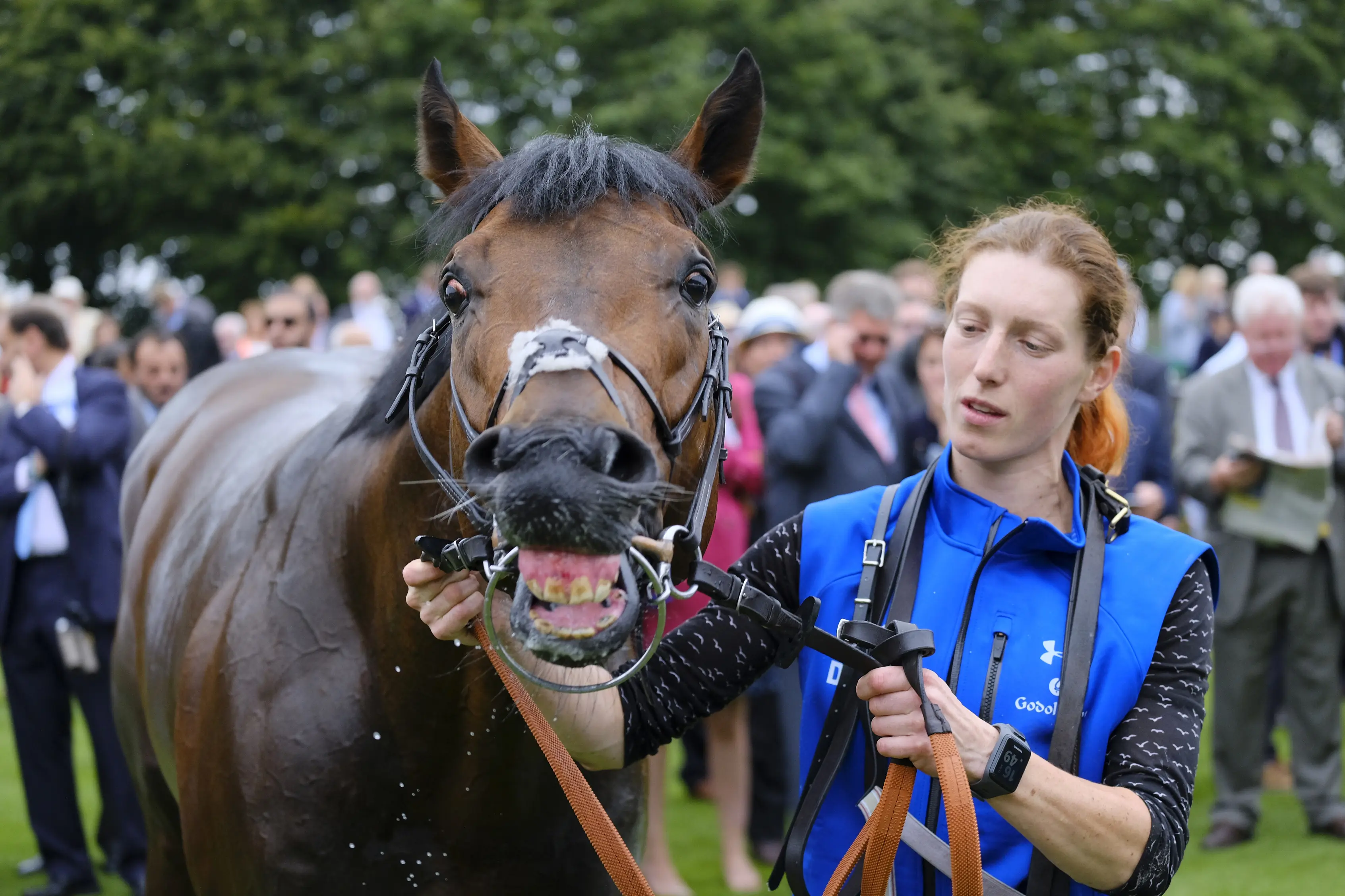
Harry Angel was fast but had an aversion to the starting stalls
Whether the rules should have been changed over Harry Angel in the first place is a moot point. He was blessed with ability and trickiness in equal measure, with his nervous behaviour before the start/in the stalls getting worse with time despite being taken to post early and the use of a Monty Roberts Stalls Rug.
The Ascot incident was an accident waiting to happen. He got upset in the stalls at Haydock next time, too, and was reluctant to load on Champions Day before being retired. He was, in effect, his own worst enemy.
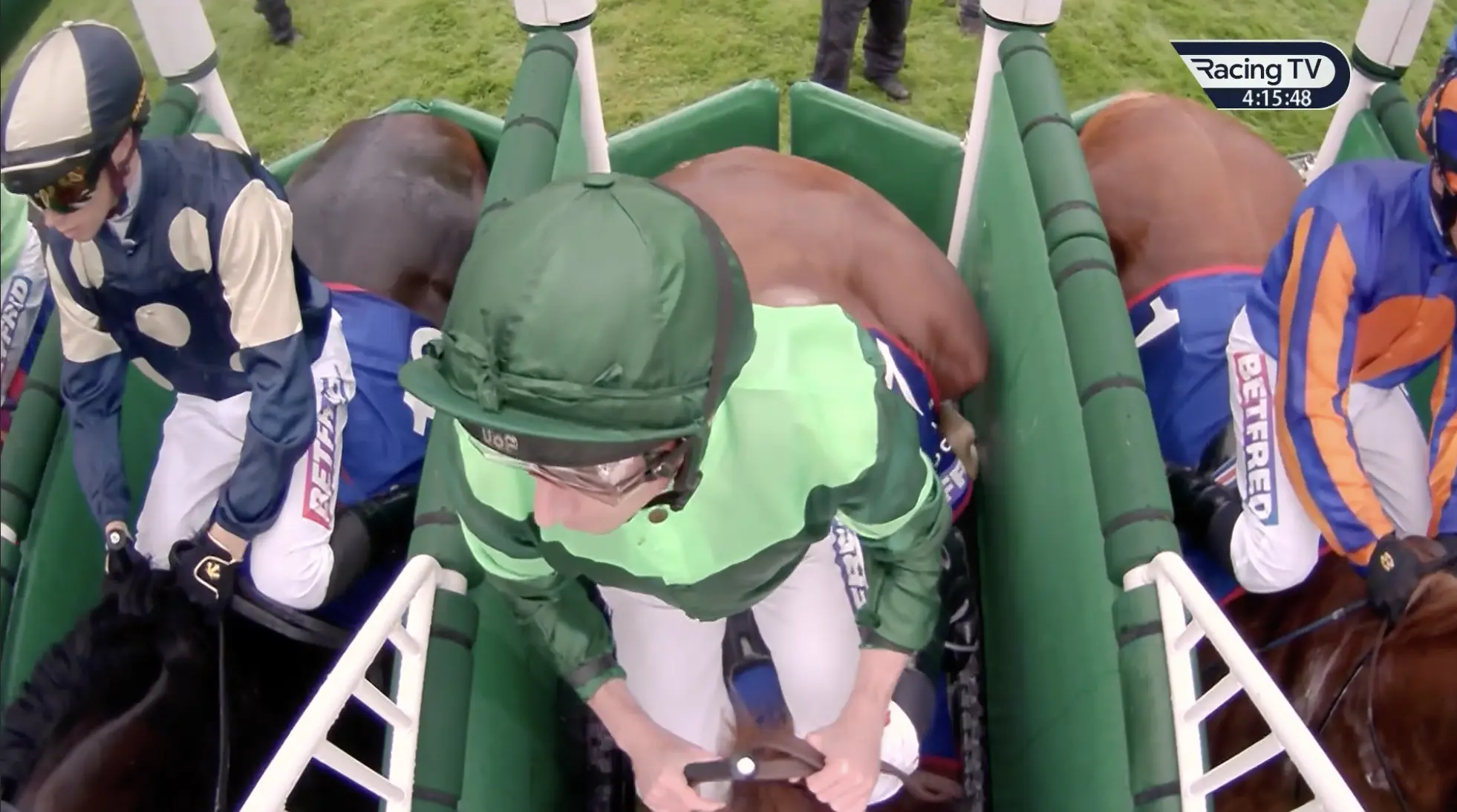
Fast forward eight years, and the BHA insist that Benvenuto Cellini was also “materially affected” by having his hind leg caught in the stalls as they opened. The Aidan O’Brien-trained colt, sent off the 3-1 favourite, trailed home a well-beaten tenth of 14 runners.
The 247th running of the race was breaking new ground. A horse who ran was deemed not to have run, with his effort expunged. He crossed the line in tenth, a position worth £20,000 in prize money for the first time, but the cash went elsewhere.
Meanwhile, winning punters had portions of their winnings deducted and bookmakers had to refund all those who backed the market leader. The uproar has been unrelenting.
So, what does the RaceiQ data tell us? Just how much ground did Benvenuto Cellini lose at the start, and was his chance “materially affected” from then on?
Let’s first rewind to when the horses were behind the stalls.
On what was a wet, windy and chilly day, Benvenuto Cellini was sweating down the neck. Chestnut horses like him can appear to sweat more compared to darker horses, but it’s not something I recall him having done in the past.
Was the occasion, part of the overall Derby test, getting to him? Maybe his future behaviour will better inform us.
The vital 3.37seconds
RaceiQ can tell us how quickly all the runners in every race reach 20mph, and Benvenuto Cellini took 3.37sec to reach that speed.
The one horse among the 14 runners to be slower away was A Taste Of Glory, who took 3.6 seconds. The winner, Christmas Day, took 2.76 seconds, which was seventh best, while the swiftest was Balzac, who got there is 2.51 seconds. Being sharp from the gates is his party trick, but it did not stop him fading to finish twelfth (promoted to eleventh).
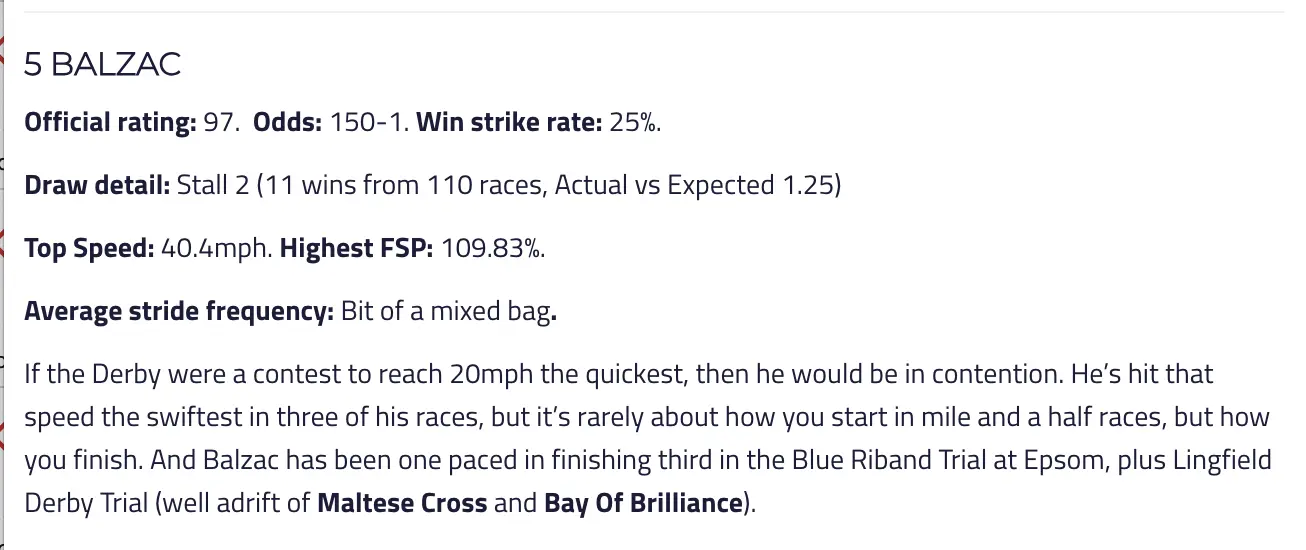
What we said about Balzac and mile and a half races in our runner-by-runner guide
To digress for a moment, Too Soon was slowest to 20mph in the 13-runner mile and a half handicap run 80 minutes after the Derby. It took him 3.38sec to hit that speed, which was a smidgeon slower than Benvenuto Cellini. He still won.
Benvenuto Cellini’s previous 0-20mph speeds have been 3.12sec; 2.89sec; 2.85sec; 4.18sec; and 3.06sec; although different tracks/ground can make the bare stats misleading.
His ranking each time is probably more relevant, and they have been eighth of 13; third of eight, second of five; first of five; and third of five. So, not a habitually electric starter, but efficient enough.
The 0-20mph formbook didn’t have him finishing 13 of 14. But he would have been a huge price to be quickest and, as in all forms of the sport, there are small margins for error.
A race where a second equalled five lengths
Fractions of seconds may not sound much, but under the prevailing conditions on Saturday a second equated to about five lengths in distance.
In other words, Christmas Day nabbed about a three-length advantage over Benvenuto Cellini plus a better early track position at the start.
Ryan Moore’s Plan A was almost certainly to be more prominent, but he was left with moments to consider Plan B (take his medicine and sit in rear) or Plan C (bustle his mount along to get closer).
He chose Plan B. Stay calm; keep our powder dry; pounce on the leaders in the latter stages. Trust that champions often overcome adversity.
That had been executed with perfection in the Oaks 24 hours earlier, when Thundering On swept from last to first up the straight on the bridle.
She had been slowest to reach 20mph of the nine runners, taking 3.14 seconds to hit that mark on better ground than 24 hours later. In fairness, that seemed by design. Her opponents varied between 2.59 seconds and 2.96 seconds.
Strong early sectionals
There was a strong early pace in the Derby, with initially plenty of “red” (fast) sectionals. In theory, that should have helped Benvenuto Cellini, if he was good enough at the business end of proceedings. After a slow start, he would not have wanted a muddling gallop.
Christmas Day was prominent all the way, but the next four home were 8th, 11th, 7th and 12th after the first furlong. So, overall, it seems racing in the second half of the field or in rear, was certainly no disadvantage.
Swinging for home, Benvenuto Cellini had moved up one place to 12th, and Moore was about to switch from motionless mode to let’s-see-what-is-under-the-bonnet mode.
And in truth, there was not a lot there.
The combination made brief headway for a furlong or so but then came a couple of taps of the Pro Cush, without any response, and an incident just over two furlongs out where he got sandwiched by his stablemate, Pierre Bonnard, and one of two maidens in the field, Alderman.
The writing was already on the wall for him by then and Moore waved the white flag for the last half minute or so, allowing him to coast home.
A 28½-length defeat
Benvenuto Cellini was beaten an aggregate of 28½ lengths, or in terms of time almost 6 seconds.
At Tattenham Corner it’s worth noting he was close to James J Braddock. That horse, having been coltish beforehand and showing his potential as a stallion, kept on well to be third.
Benvenuto Cellini’s top speed in the race was 36.42mph, which was fourth fastest. James J Braddock was marginally quickest, clocking 36.66mph.
The favourite’s massive stride pattern was a focus before the race and metrics such as his average stride frequency (2.1 strides per second), average stride length (6.91 metres) and peak stride (7.74 metres) again compared well with the opposition.
However, the numbers he recorded were nothing like those he’s capable of producing on fast going. The testing conditions meant he was having to work much harder, and perhaps the nature of the track was not for him either.
BHA stance
The BHA said on Monday: “The rationale behind the rule is that it is unfair to the betting public to lose their money on a horse who is prevented from starting on equal terms.
“The unanimous decision reached by a highly-experienced stewarding panel was that the horse was prevented from starting on equal terms and that, as a consequence, his chance in the race was materially affected.
“If the starter had been aware that the horse was on three legs, with his leg physically entangled in the stalls, and his chances were going to be impacted in the race, he would not have enacted the start. The horse’s leg would have been released, taken out of the stalls and checked by a veterinary officer and then reloaded if safe to do so.”
But was Benvenuto Cellini really "materially affected", or did he just get off to an awkward start?
Looking at the data, you would have to conclude the stewards got it wrong.

Related posts
Under The Radar: Paddy Magee nominates three to follow
Ross Millar's Monday tips: "he is undeniably well handicapped"
William Buick set to be reunited with Touleen at Ascot
Bond Thoroughbreds: the inside track on their top team
Trustyourinstinct flies home to land Curragh Cup
Featured offers

Bet £10 get £30 in Free Bets with BallyBet
T&Cs Apply
Claim Now

Get a £50 free bet when you bet £50 with Coral
T&Cs Apply
Claim Now

Bet £10 get £40 in free bets with Kwiff
T&Cs Apply
Claim Now

Bet £10 Get £40 in free bets + Money back 2nd to SP fav with BOYLE Sports
T&Cs Apply
Claim Now

Bet £10 get £30 in Free Bets with TalkSportBet
T&Cs Apply
Claim Now
Copyright 2026 Racing TV - All Rights Reserved.
Please bet responsibly
Copyright 2026. All rights reserved