Login
WATCH FREE
DRF and Cheltenham trends: Willie Mullins second strings
By Racing TV
Last Updated: Fri 31 Jan 2025
Cheltenham Festival trends writer Matt Tombs casts his eye on the Dublin Racing Festival and a potential angle for punters to note when it comes to identifying which Willie Mullins runners might prove profitable to follow.

Enjoy a Racing TV free trial and watch EVERY race live from the Dublin Racing Festival! Hurry, this offer must end Sunday.
Understanding whether a trainer - who goes mob-handed for a Grade One - knows their pecking order or not has increasingly become an important factor in punting.
In practice the focus is on ‘novices’ (here including juveniles), as trainers will generally have fewer problems working out a pecking order once horses are in open company. That novice pecking order will get established eventually, but when that typically happens depends on the trainer’s method.
With the Dublin Racing Festival (“DRF”) this weekend, it is a good time to kill two birds at once and look in depth at how well Willie Mullins knows the pecking order of his novices at both DRF and Cheltenham.
Novice picture murky at Closutton
I think this is a particularly good year to be examining this question, as the Mullins novice picture is still really murky. In the novice hurdle division it may be that Mullins lacks stars this season but, equally, it may be that he has several but they've only been seen in maidens so far.
For the DRF I’ve looked at the two novice hurdles, the juvenile hurdle and the two novice chases and then examined how they feed in to the relevant Grade Ones at the Festival (I’ve kept the now defunct Turners in the grid as it helps illustrate the history).
For context, I’ve set out the proportion of runners Mullins had in those races in 2024 in the grid below:
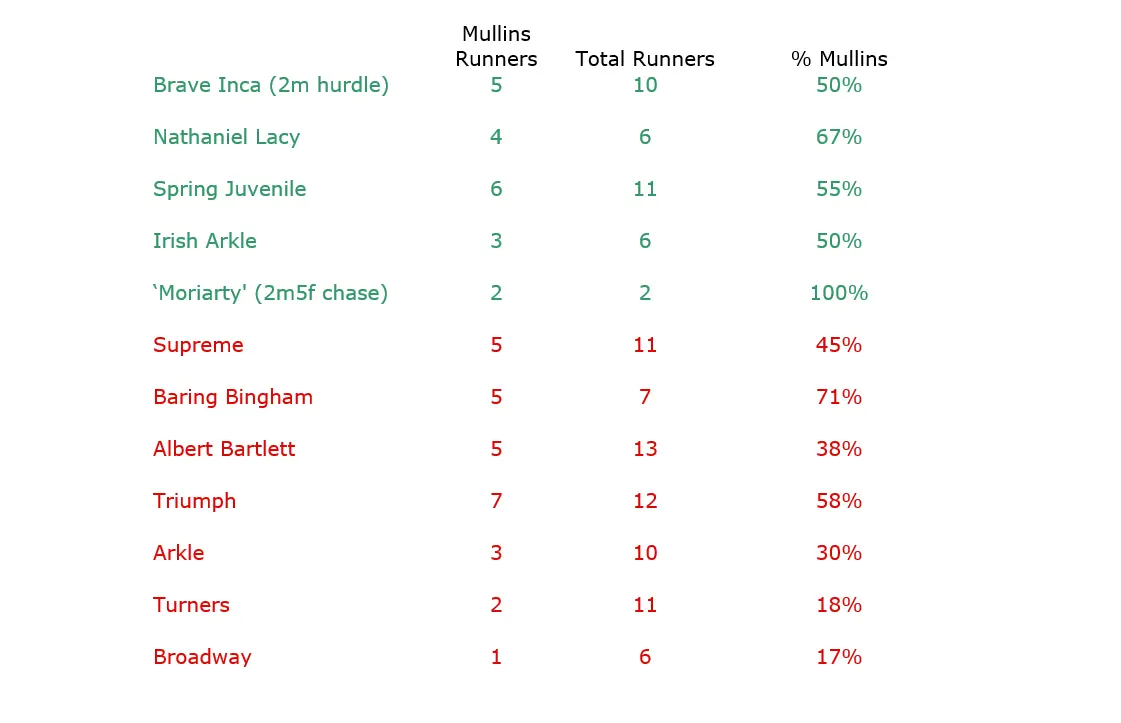
In total in 2024, Mullins had 57 per cent of the runners in those five DRF races, winning them all. He had 40 per cent of the runners in the seven novice/juvenile Grade Ones at Cheltenham, winning four of them.
It’s well known that Mullins' method has become increasingly spring-focused. It depends partly on the weather, but his best novices often don’t run in the Grade Ones before the turn of the year as they weren’t out early enough to have won their maiden hurdles or beginners chases in time.
This season has been unusually dry in Ireland and this has had a couple of impacts. Firstly, the simple one - Closutton horses being out even later than usual - but secondly in terms of the results. Mullins' strike-rate at the Irish ‘Christmas Festivals,’ (Leopardstown, Limerick and Down Royal) was 10 per cent, compared to between 22 per cent and 26 per cent in the previous three years.
As is well documented, some of Mullins' team were under the weather at Christmas and that had an impact too. The last really dry winter in Ireland was 2018/19, when Mullins' strike-rate at those Christmas Festivals was 19 per cent. I’d expect his strike-rate to be slightly lower when the ground is drier, but those strike-rates illustrate that when trying to establish the pecking order of the Mullins novices this season the position is confused by the fact that plenty of Closutton horses weren't running to form at Christmas.
When does Mullins know his novice pecking order?
Given that context, the big question becomes: “When does Mullins know the pecking order of his novices?” By understanding this question, we can bet more effectively at both DRF and Cheltenham.
The way I’ve tackled it is to look at all the Grade One renewals of all these races this century where Mullins has run more than one horse. Before DRF began in 2018, these five races were run on two Leopardstown cards either side of what’s now DRF weekend.
To determine the pecking order, I have simply used the market order at SP (in practice this question can be clouded, e.g. the stable jockey not being able to ride a horse because the owner retains a jockey, but I’ve ignored such factors for simplicity.)
I’ve looked at how well Mullins knows his pecking order in two ways. The first is simply the percentage of times his first string in the market does best of his runners. As it’s winners we’re after, the second is just to look at the renewals of these races Mullins has won (where he’s run more than one), and see how often his first string in the market triumphed.
Tattersalls ' Novice Hurdle (Brave Inca)
The Brave Inca has been a Grade One since 2003 and was run over 2m2f until the DRF began in 2018, since when it has been run over 2m. The Supreme tends to be strongly run and a stiff test at 2m87y, whereas the Baring Bingham (this year the Turners Novice Hurdle) tends to be steadily run and a test of speed at 2m5f. Whether the Brave Inca has been run over 2m or 2m2f, it has been an excellent trial for both, producing seven Supreme winners and five Baring Bingham winners this century.
The results are in the grid below:
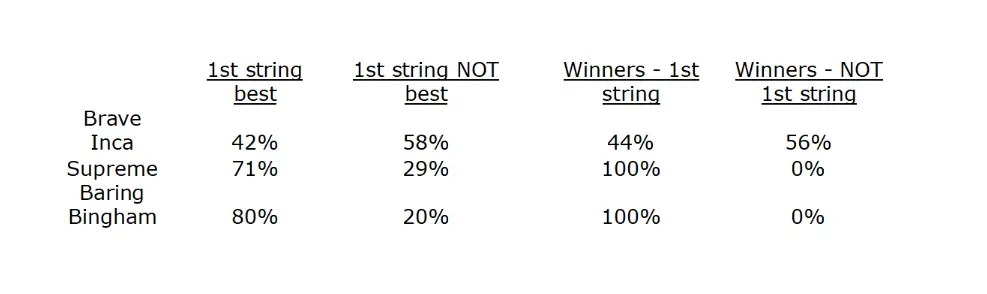
This illustrates that Mullins often doesn’t know his pecking order in the Brave Inca. It’s more common for one of his supposed lesser lights to do best of his and - crucially - more common for them to win than his first string in the market.
Given Mullins' spring-focused training methods, and his novice hurdlers often having run minimally before DRF, the Brave Inca is often the race where he finds out the pecking order of his speedy novice hurdlers. When betting in the Brave Inca, the value amongst the Mullins horses is usually with the second strings.
Of these five DRF races, this is probably the hardest to work out which will be the Mullins first string. There’s little between Kopek Des Bordes and Kaid D’authie in ante-post markets and either could go off favourite.
Enjoy an On The Wire special: our top team look ahead to the Dublin Racing Festival and share their top tips
With Henry de Bromhead’s horses not firing on all cylinders at the moment I wouldn’t take the collateral form lines of the win of Kawaboomga at Fairyhouse on Saturday literally, but that gave Kopek Des Bordes’ form a bit of a boost all the same and I think he’s the most likely winner.
By Cheltenham, Mullins invariably knows the pecking order of his speedy novice hurdlers. It’s relatively unusual for the first string not to do best. When that happens, the reason is usually that the first string hasn’t run to form (e.g. Getabirdwas too free in the Supreme, Bacardyswas taken out by a faller in the Baring Bingham) rather than a stablemate simply proving superior.
The result is that when Mullins has won the Supreme or Baring Bingham, it has always been with his first string (when running more than one Mullins has won both races five times). If you want to back a Mullins horse in those races, you need to be on the first string.
Nathaniel Lacy & Partners Novice' Hurdle
Final Demand is a warm order for Mullins in the DRF contest this year
At the DRF it’s a similar story in the staying novice hurdle, the 2m6f Nathaniel Lacy, but very different in the Albert Bartlett:

The results reflect Mullins' method but, additionally, the inherently much less predictable nature of the Albert Bartlett, where 10 of the last 11 winners went off a double-figure SP.
Similarly to the Brave Inca, the value is generally with Mullins second strings in the Nathaniel Lacy.
This year Mullins has Final Demand (7/4 ante-post favourite at the time of writing). He had a reputation from the pointing field and bolted up at Limerick on his hurdling debut, while the placed horses have won since. He could be anything but he looked a bit green at Limerick, lugging to his right at the business end. This is a tough race for such an inexperienced horse - indeed, no horse has won it off one hurdles run.
Terrific prospect though he looks, I’ll take him on with 5/1 chance Supersundae. He has lots of hurdling experience, including in last year’s Supreme, and ran a blinder in the Grade One at Naas given he was keen on seasonal reappearance. He was well backed there and I’d hope he’ll settle better with that run under his belt. He has a decent chance of turning the favourite over.
With the staying novice hurdlers, the DRF doesn’t tend to sort out Willie’s pecking order.
The test usually provided by the Albert Bartlett differs much more from the trials compared to the Supreme or Baring Bingham, the main reason why the longer race is so unpredictable. It’s a race to take on those at the front of the market - including Mullins’ first string - and find value in his other runners at bigger prices.
Gannon's City Juvenile Hurdle (Spring)
In the juvenile division it’s a similar story at DRF but a slightly nuanced position at Cheltenham:
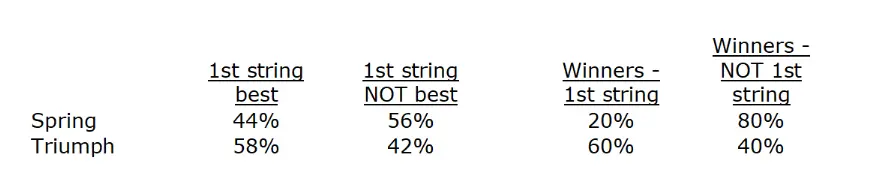
The Triumph is a much more predictable race since the introduction of the Fred Winter and the significant reduction in field sizes. In that sense, it’s no surprise to see Mullins' first strings usually doing best. I suspect the reason the results aren’t as stark compared to the Supreme and Baring Bingham may be that four-year-olds are more immature. Compared to the older novices, they tend to improve more and at different times during the season.
The Spring Juvenile Hurdle (this season the Gannon’s) therefore doesn’t establish a pecking order in the same way the Brave Inca does. That’s reflected in the fact that, since becoming a Grade One in 2010, the Spring has produced nine Triumph winners (it is comfortably the best trial) but only three were doing the double. The value in the Triumph can often be with the beaten horses in the Spring – whether trained by Mullins or not.
Just as the Spring form often gets turned round in the Triumph, the form from the Grade Two here at Christmas - the O’Driscolls - often gets turned round in the Spring.
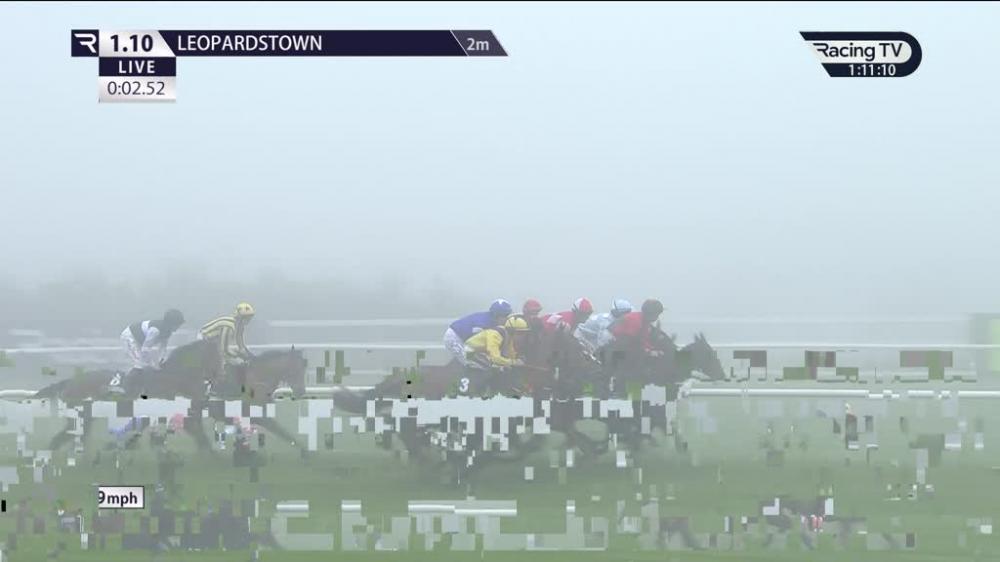
Hello Neighbour comes out on top at Leopardstown over Christmas - but will he confirm placings?
Winners of the O’Driscolls are 1/10 in the Spring since it became a Grade One in 2010, yet the placed horses are 5/16 – you’d have made a 27pt (172 per cent) profit backing them, with four of the five winners turning the form round with the O’Driscolls winner.
The first three home in this season's O’Driscolls all looked works in progress and how much they’ll improve in the Spring is hard to gauge. Sony Bill was very keen in the O’Driscolls, ridden with plenty of light. If he settles better here - perhaps with a change of tactics - the 14/1 ante-post could prove good value.
More clues with novice chasers
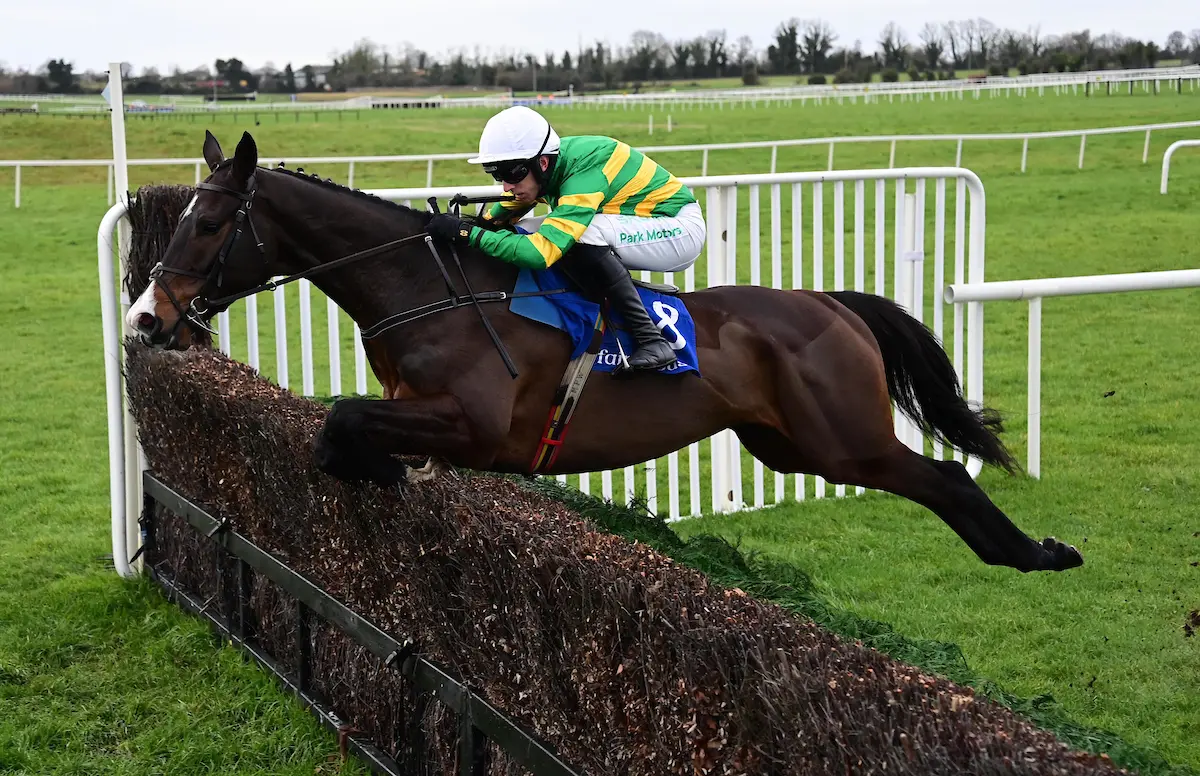
Given that novice chasers have generally had a season (or more) hurdling, you’d expect Mullins to have a better idea of his pecking order earlier in the season. That’s been the case, especially in the more specialist division at around the minimum trip:
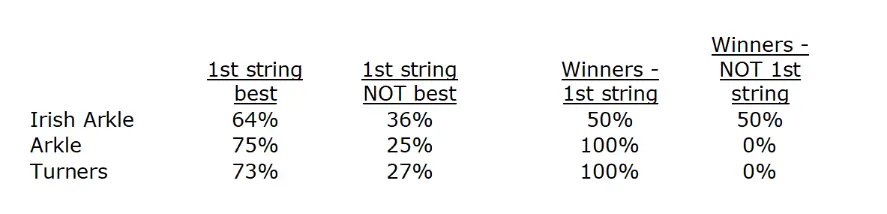
Unlike those three hurdles races at DRF, the Mullins first string does best in the Irish Arkle more often than not, but given it's 50:50 in terms of winners it’s generally best to be open-minded about where the value with the Mullins runners might be.
When using these sorts of trends, as with any analytical tool, it’s important to factor them in to your overall process - don’t let them dictate that process.
Despite only 50 per cent of Mullins' winners being his first strings, I would strongly fancy Majborough to beat Ile Atlantique. Last season’s juveniles have proved as strong a crop as I can remember (and the form of the older novices hasn’t worked out that well). I think Majborough is a banker here en-route to a clash with Sir Gino at Cheltenham.
The Irish Arkle, which became a Grade One in 2002, is run over 2m1f (or sometimes a little further). Therefore, similarly to the Brave Inca, it is a trial for the Arkle (1m 7f 199y) and previously also the Turners, (distance depended on dolling out but last year ran over 2m 3f 214y).
Mullins does learn about his pecking order from the Irish Arkle with the record of his first string in both the Arkle and Turners slightly better. The key difference is the winners – similarly to the Supreme and Baring Bingham, you only want to back the Mullins first string in the Arkle, (and previously the Turners.)
The final DRF race, the novice chase run over an extended 2m5f, (the ‘Moriarty’ in old money,) which also became a Grade One in 2002, illustrates the different factors I’ve mentioned:

Mullins knows his pecking order here better than in the novice hurdles, but possibly not quite as well as in the more specialist Irish Arkle (although a higher proportion of his winners have been first strings.)
Having been trounced over 2m last time by Sir Gino and jumped a bit carefully on both starts, Ballyburn has a few questions to answer now. He may just be the stayer his breeding suggests and still prove a top-class novice, but he looks a bit short at 8/13 ante-post.
The vibes are that Mullins' only other runner may be Champ Kiely. He’s nine but returned from 614 days off to win what may turn out to be an ordinary beginners' event at Fairyhouse on New Year’s Day. He’s 7/2 ante-post and a bit of an unknown quantity coming here, not least going left-handed, but at the prices I suspect he's better value than Ballyburn.
At Cheltenham, the ‘Moriarty’ is a trial for the 3m110y Broadway (Brown Advisory Novice Chase) and previously the Turners. As with the Albert Bartlett over a similar distance, Closutton first strings usually don’t do best in the Broadway. That’s despite the Broadway - during the era of four level-weights novice chases at the Festival - being much more predictable than the Albert Bartlett.
Only two of Mullins' six Broadway winners came in renewals where he ran more than one, so I wouldn’t read much into the 50:50 stat, but the overall record of his first strings suggests the Broadway is a race where the value may be with his second strings – especially as it now ought to be more competitive with there being two less level-weights novice chases.
And now... the tips!
In summary, there should be plenty of value at DRF this weekend amongst Mullins' supposed lesser lights – especially in the Brave Inca, Nathaniel Lacy & Spring Juvenile.
Once the DRF has been run, it can be a good time to be backing clear Mullins first strings ante-post in the races over short and intermediate trips at Cheltenham. They will often shorten a lot by the off, although the uncertainty over targets needs factoring in and NRNB can sometimes be the best way to play.
Over longer distances, the value tends to be with the supposed lesser lights, especially in the Albert Bartlett. They tend to be bigger prices post-declarations so it’s often a good idea to hold fire until final fields are known.
A suggested speculative double of the supposed Mullins lesser lights for DRF weekend is Supersundae (1.15 Saturday) and Sony Bill (1.50 Saturday).
More essential viewing and reading

Only 500 left! This is your last chance to try Racing TV before the Cheltenham Festival! Enjoy a Racing TV free trial.
Related posts
Sheikh Ahmed bin Rashid Al Maktoum dies aged 76
Richard Hannon breaks new ground with North American winner
Guinness Kerry National: guide to the key players
Craig Williams booked for James J Braddock mount in Melbourne Cup
Winless Ones To Watch: five more Jumps horses to follow this season
Featured offers

Bet £10 get £40 in free bets with Kwiff
T&Cs Apply
Claim Now
New UK customers. Place a £10 real money bet at min. 2.0 odds within 5 days of deposit. Get 4 x £10 Free Bets: 1 Single, 2 Accas & 1 Bet Builder (min. 3 selections each). Excludes cashout, E/W, Multis, Ineligible Markets & Odds Boosts. Credited after bet settlement. 7-day expiry. T&Cs apply. 18+ GambleAware
Bet £10 get £30 in Free Bets with talkSPORT BET
T&Cs Apply
Claim Now
talkSPORT BET: Bet £10 get £30 in Horse Racing Free Bets. 18+ GambleAware

Bet £20 and Get £40 in Free Bets with Unibet
T&Cs Apply
Claim Now
Unibet: Bet £20 and Get £40 in Free Bets with Unibet

Get 50% back up to £50 with QuinnBet
T&Cs Apply
Claim Now
New UK Customers Only. Bet £10+ on any sportsbook markets at odds of evens (2.00) or greater. Get 50% back of your first day’s losses as a Free Bet up to £50, valid for 7 days. 18+ GambleAware.

Bet £10 Get £40 in free bets + Money back 2nd to SP fav with BOYLE Sports
T&Cs Apply
Claim Now
BOYLE Sports: Bet £10 Get £40 in free bets + Money back 2nd to SP fav with BOYLE Sports. 18+ GambleAware
Copyright 2026 Racing TV - All Rights Reserved.
Please bet responsibly
Copyright 2026. All rights reserved