Login
Join
50+
What Is The Horse Racing Handicap?
Most people who watch horse racing have noticed and heard the term ‘handicap’ being thrown around frequently, and you might be wondering what a handicap is in horse racing. With it being quite similar to handicaps in other sports, it is a way to make horse races fairer, more competitive and more interesting for fans and bettors alike.
At Racing TV, we are going to go through what a handicap is, what a handicap race is and how this can affect betting.
What Is The Handicap In Horse Racing?
A handicap in horse racing is assigning each horse a specific weight to carry, based on its official rating or past performance. The better the horse, the more weight it will carry.
Horse racing handicaps aim to make it a level playing field, so all horses have an equal chance of winning, as the faster horses will have to carry more weight, therefore making them slower.
If you are wondering exactly how it works, here is a quick rundown of all the aspects that surround handicaps in horse racing:
•
Every horse is given an official rating by a racing authority (e.g. the BHA in the UK).
•
A handicapper assigns weights based on that rating.
•
Higher-rated horses carry more weight (saddles + lead weights).
•
Lower-rated horses carry less weight to help them compete more fairly.
What Is A Handicap Race?
Not every type of horse race features handicaps, so there are specific handicap races where each horse is assigned a specific weight. This theoretically gives every runner a fighting chance and makes betting on handicap races more unpredictable compared to traditional horse races.
Without handicap races, every race would be quite predictable, leading to poor odds and boring watches. There are a handful of reasons why handicap races are a good addition to horse racing:
•
Encourages closer finishes
•
Gives lesser horses a chance to shine
•
Makes races more unpredictable
•
Allows for better odds
Check out some our top Betting Offers:
Featured offers

Bet £10 get £40 in Free Bets with BetwayT&Cs Apply
Claim Now
New customers only. Place a min £10 pre-event bet at min odds of 2.0. £40 worth of Free Bet Tokens awarded on bet settlement. 4 x £10 each with betting restrictions. 7 day expiry. Debit Card deposits only (exclusions apply). Bet The Responsible Way Full Terms apply. 18+ GambleAware

Bet £10 Get £30 in Free Bets + Money Back as a Free Bet if 2nd to SP Fav with BOYLE SportsT&Cs Apply
Claim Now
18+. New UK customers (Excluding NI) only. Min Deposit £10. Min stake £10. Min odds Evs. Free bet applied on 1st settlement of any qualifying bet. 30 days to qualify. Free bets expire in 7 days. Cashed out/Free Bets won’t apply. Account & Payment method restrictions apply. 1 Free Bet offer per customer, household & IP Address only. T&C's apply. 18+. IRE/NI & UK online only. Max Free Bet £/€10. Win or win part of e/w outright singles. 5+ runners. 1st bet on each race. Free/void/antepost bets don't qualify. In event of a dead heat, offer won’t apply. Applies to First Past the Post result. Unnamed 2nd Favs don’t qualify. Acc & Payment restrictions apply. T&Cs apply.

Bet £10 get £40 in free bets with KwiffT&Cs Apply
Claim Now
New UK customers. Place a £10 real money bet at min. 2.0 odds within 5 days of deposit. Get 4 x £10 Free Bets: 1 Single, 2 Accas & 1 Bet Builder (min. 3 selections each). Excludes cashout, E/W, Multis, Ineligible Markets & Odds Boosts. Credited after bet settlement. 7-day expiry. T&Cs apply. 18+ GambleAware

Bet £20 and Get £40 in Free Bets with UnibetT&Cs Apply
Claim Now
18+. GambleAware.org. New GB customers only. Min £20 debit card or instant banking transfer deposit. Place a £20+ bet on Horse Racing at min odds 2/5 (1.4) each leg for 4x £10 Free Bets (can be used on Racing Bet Builder). Claim within 30 days. Valid for Horse Racing only. Geographical restrictions and Further T&C’s apply
How Do Handicap Races Work?
With horses being given official ratings by a handicapper, these ratings normally range between 0 and 120+, depending on the racing jurisdiction and code. A horse rated 100 might carry 60kg, whilst a horse rated 90 might carry 59kg. Usually, as a rule of thumb, a difference of 1 rating point = around 0.5kg in weight carried.
If we use an example of a race with five horses, we can see how their rating would affect the weight they carry:
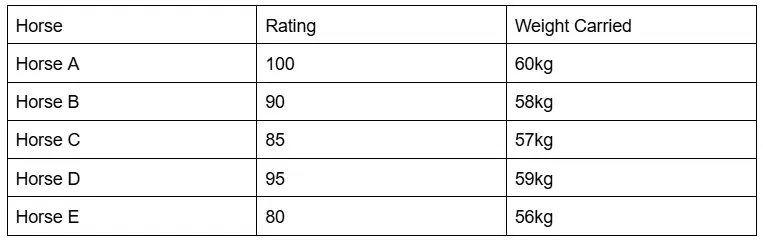
An example of 5 horses showing how their rating affects the weight they carry.
Types of Handicap Races
When looking to use free bets and place bets across horse races, you need to check what type of race you are betting on, as this can influence how the sport unfolds. In horse racing, there are a handful of different handicap races that are available throughout the calendar:
•
Flat Handicaps – Run on level ground, weights based on speed and stamina.
•
Jump Handicaps – Involve hurdles or fences, factoring in jumping ability and stamina.
•
Nursery Handicaps – For two-year-old horses in flat racing.
•
Heritage Handicaps – Big-money, prestigious handicap events (like the Ebor Handicap).
Betting On Handicap Races
Handicap races are often seen as good opportunities for value betting due to the favourite being hindered, and the slower horses being given a better chance. This makes form analysis complex and potentially rewarding to those who have the best horse racing tips.
Handicap races are usually larger fields, too, meaning the odds will be better as there are more options to choose from. Understanding how weight affects a horse, especially over long distances or jumps, is crucial to making the most of these races.
Handicaps In Horse Racing
In horse racing, handicaps are the great equaliser, and they make even the most unmatched races fair and interesting. For bettors, handicaps offer the chance to find hidden value, beat the market, and experience some incredibly fascinating features.
If you are interested in more horse racing content, Racing TV is filled with detailed racecards, guides and tips all to do with the sport of racing.
Copyright 2026 Racing TV - All Rights Reserved.
Please bet responsibly
Copyright 2026. All rights reserved