Login
Join
50+
What Is Rule 4 in Horse Racing?
If you’ve ever placed a bet on a horse race, seen your horse win, and noticed that your payout was less than expected, you’ve likely been introduced, without warning, to Rule 4. To make things clear, Rule 4 is not some sneaky trick, but it is a standard deduction used in horse racing, so if you watch horse racing often, it is a rule that you should understand.
Here, we will explore what Rule 4 is, how it operates in races, and how it can impact betting scenarios.
What Is Rule 4?
Rule 4 is a set of standardised deductions bookmakers apply when a horse is withdrawn from a race after you’ve placed a bet, but before the race starts.
It’s used to adjust your payout fairly when the odds for the remaining runners improve due to a key rival dropping out.
This rule ensures that bettors don’t get unfairly inflated winnings when a strong contender is removed, making their horse more likely to win than when the bet was placed.
Let’s say you backed Horse A at 5/1, and Horse B (the 2/1 favourite) gets pulled from the race at the last minute.
Now Horse A is the new favourite and the odds shorten. If everyone still got paid at the original 5/1, it wouldn’t reflect the new likelihood of that horse winning. That’s where Rule 4 comes in.
How Does Rule 4 Work?
When a horse is withdrawn from the racecards after the final declarations (typically the day before the race), bookmakers apply a Rule 4 deduction based on the odds of the withdrawn horse at the time it was pulled out.
The deduction is taken from your winnings only, not your stake.
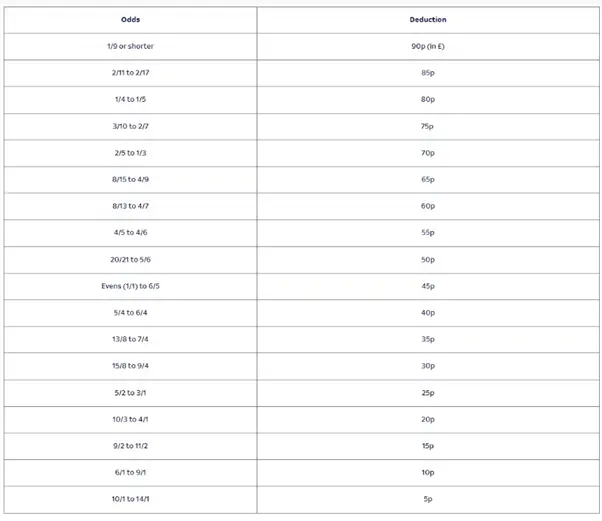
Here are the available deductions that will take place if a horse has been withdrawn, and as you can see, the deduction amounts are different depending on what the odds are.
Check out some our top Betting Offers:
Featured offers

Bet £10 get £40 in Free Bets with BetwayT&Cs Apply
Claim Now
New customers only. Place a min £10 pre-event bet at min odds of 2.0. £40 worth of Free Bet Tokens awarded on bet settlement. 4 x £10 each with betting restrictions. 7 day expiry. Debit Card deposits only (exclusions apply). Bet The Responsible Way Full Terms apply. 18+ GambleAware

Bet £10 Get £30 in Free Bets + Money Back as a Free Bet if 2nd to SP Fav with BOYLE SportsT&Cs Apply
Claim Now
18+. New UK customers (Excluding NI) only. Min Deposit £10. Min stake £10. Min odds Evs. Free bet applied on 1st settlement of any qualifying bet. 30 days to qualify. Free bets expire in 7 days. Cashed out/Free Bets won’t apply. Account & Payment method restrictions apply. 1 Free Bet offer per customer, household & IP Address only. T&C's apply. 18+. IRE/NI & UK online only. Max Free Bet £/€10. Win or win part of e/w outright singles. 5+ runners. 1st bet on each race. Free/void/antepost bets don't qualify. In event of a dead heat, offer won’t apply. Applies to First Past the Post result. Unnamed 2nd Favs don’t qualify. Acc & Payment restrictions apply. T&Cs apply.

Bet £10 get £40 in free bets with KwiffT&Cs Apply
Claim Now
New UK customers. Place a £10 real money bet at min. 2.0 odds within 5 days of deposit. Get 4 x £10 Free Bets: 1 Single, 2 Accas & 1 Bet Builder (min. 3 selections each). Excludes cashout, E/W, Multis, Ineligible Markets & Odds Boosts. Credited after bet settlement. 7-day expiry. T&Cs apply. 18+ GambleAware

Bet £20 and Get £40 in Free Bets with UnibetT&Cs Apply
Claim Now
18+. GambleAware.org. New GB customers only. Min £20 debit card or instant banking transfer deposit. Place a £20+ bet on Horse Racing at min odds 2/5 (1.4) each leg for 4x £10 Free Bets (can be used on Racing Bet Builder). Claim within 30 days. Valid for Horse Racing only. Geographical restrictions and Further T&C’s apply
Rule 4 Example
To understand Rule 4, we have some real examples that can help you understand exactly how this ruling works. If you are ever wondering why you might be getting fewer returns than expected on your free bets and sports betting, then the Rule 4 might be to blame.
Here is a quick example of how this rule works:
You bet £10 on Horse A at 4/1. Horse B (the 2/1 favourite) is withdrawn after you place your bet. The Rule 4 deduction is 50p per £1 of winnings.
Your expected return before Rule 4:
•
£10 at 4/1 = £40 profit
•
£10 stake = £50 total return
Rule 4 deduction:
•
50p × 40 = £20 deducted
•
Final return: £30 total (£20 profit + £10 stake)
Important Information About Rule 4
Whilst Rule 4 can be quite confusing, there are also some other vital pieces of information that you must learn about. For example:
•
Rule 4 only applies to fixed-odds bets, not tote or exchange bets.
•
If multiple horses are withdrawn, multiple deductions may apply (usually capped at around 90p).
•
If you bet after the withdrawal, Rule 4 doesn’t apply—you’ll get the new, shorter odds.
•
Deductions do not affect your stake; only your winnings are impacted.
If you are looking to avoid Rule 4, then the best thing to do is to be aware of the likelihood of withdrawals, and if you bet early, you are leaving yourself susceptible to the rule, especially in short-priced favourites.
Rule 4 In Horse Racing
Rule 4 might seem frustrating at first—especially when it chips away at your expected winnings—but it’s an essential part of ensuring fairness in horse racing betting. When a strong favourite is withdrawn, it changes the entire landscape of the race. Rule 4 ensures that payouts remain reflective of the true risk involved at the time your bet was placed.
By understanding how Rule 4 works, you’ll avoid surprises at payout time and become a more informed, strategic bettor. Whether you’re betting early or close to the off, being aware of potential non-runners and how deductions are calculated gives you a valuable edge.
If you are looking to learn more about horse racing, Racing TV is full of fantastic guides, horse racing tips and livestreamed racing to ensure you keep up with all the action. For those who are looking to plan ahead, check out our racecards, which are available on site.
Copyright 2026 Racing TV - All Rights Reserved.
Please bet responsibly
Copyright 2026. All rights reserved