Login
Join
50+
How To Read Horse Racing Form?
Horse racing is a simple sport when it comes down to its fundamentals, with jockeys and their horses being pitted against each other to see who can make it to the finish line first. However, if you are new to horse racing, the numbers and letters that are found in horse racing racecards can look like code, and in a way, they are!
At Racing TV, we are going to look at how you can read horse racing form, what every different symbol means and how you can follow races with confidence, whether you are at the track, watching from home, or placing a bet online.
What is Horse Racing Form?
Horse racing form refers to a horse’s recent performance history in races. It’s typically displayed next to the horse’s name as a string of numbers and letters, with each symbol representing how the horse ran in past competitions.
Form: 5123F
Each digit or letter tells you how the horse placed in its previous races, from 1st place finishes to falls and pulled-up runs.
How To Read The Form Line
Let's have a look at the symbols that can be used in the form line, and how they relate to the example above
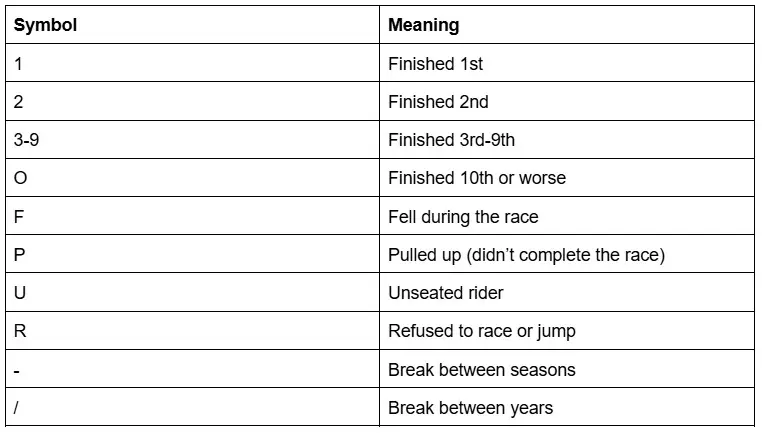
Symbols you will find on a form line and what they mean.
The most recent result is shown last, so by using the example of 5123F, we can see that the horse:
•
Finished 5th, then won a race, then finished 2nd, then 3rd, and then fell in its most recent race.
What Else Appears on Racecards?
When you watch horse racing, there are plenty of other things that can appear on a racecard, including other important details such as:
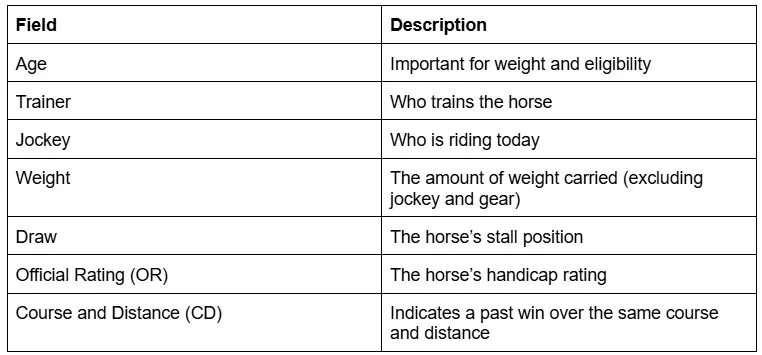
Other details that you will see on a racecard and what they mean.
Check out some our top Betting Offers:
Featured offers

Bet £10 get £40 in Free Bets with BetwayT&Cs Apply
Claim Now
New customers only. Place a min £10 pre-event bet at min odds of 2.0. £40 worth of Free Bet Tokens awarded on bet settlement. 4 x £10 each with betting restrictions. 7 day expiry. Debit Card deposits only (exclusions apply). Bet The Responsible Way Full Terms apply. 18+ GambleAware

Bet £10 Get £30 in Free Bets + Money Back as a Free Bet if 2nd to SP Fav with BOYLE SportsT&Cs Apply
Claim Now
18+. New UK customers (Excluding NI) only. Min Deposit £10. Min stake £10. Min odds Evs. Free bet applied on 1st settlement of any qualifying bet. 30 days to qualify. Free bets expire in 7 days. Cashed out/Free Bets won’t apply. Account & Payment method restrictions apply. 1 Free Bet offer per customer, household & IP Address only. T&C's apply. 18+. IRE/NI & UK online only. Max Free Bet £/€10. Win or win part of e/w outright singles. 5+ runners. 1st bet on each race. Free/void/antepost bets don't qualify. In event of a dead heat, offer won’t apply. Applies to First Past the Post result. Unnamed 2nd Favs don’t qualify. Acc & Payment restrictions apply. T&Cs apply.

Bet £10 get £40 in free bets with KwiffT&Cs Apply
Claim Now
New UK customers. Place a £10 real money bet at min. 2.0 odds within 5 days of deposit. Get 4 x £10 Free Bets: 1 Single, 2 Accas & 1 Bet Builder (min. 3 selections each). Excludes cashout, E/W, Multis, Ineligible Markets & Odds Boosts. Credited after bet settlement. 7-day expiry. T&Cs apply. 18+ GambleAware

Bet £20 and Get £40 in Free Bets with UnibetT&Cs Apply
Claim Now
18+. GambleAware.org. New GB customers only. Min £20 debit card or instant banking transfer deposit. Place a £20+ bet on Horse Racing at min odds 2/5 (1.4) each leg for 4x £10 Free Bets (can be used on Racing Bet Builder). Claim within 30 days. Valid for Horse Racing only. Geographical restrictions and Further T&C’s apply
Understanding Horse Racing Form
When looking to read horse racing form, there are plenty of things to take into consideration when using this information to your advantage.
Look for:
•
Consistency: Has the horse been finishing in the top positions regularly?
•
Improvement: Is the horse getting better as races go on?
•
Layoffs: Has the horse been off track for a while?
•
Track & ground preferences: Some horses run better on specific surfaces or at specific tracks
Now that we know what to look for, let's check out a full example so that you can gain a comprehensive understanding of horse racing form.
Horse: Midnight Runner
Age: 5
Form: 3/65-21
Trainer: A. Johnson
Jockey: T. McBride
Weight: 11-2
CD Winner
From this example, we can take some interesting points, such as:
•
The horse finished 3rd two years ago
•
It then finished 6th and 5th last season
•
Has had a strong comeback after the season break with a 2nd and first place
•
Course and distance winner
From these facts, we can see that the horse is clearly in form and is a proven winner for today’s race setup.
Conclusion on Horse Racing Form
Reading horse racing form may seem daunting at first, but once you get the hang of it, it opens up a new level of understanding. You’ll quickly begin spotting horses with potential and avoiding those that are out of sorts. Along with horse racing betting tips, understanding the form of the horses taking part can provide bettors with greater insight into those competing.
Remember:
•
Don’t rely on form alone — always consider the trainer, jockey, ground, weight, and trip.
•
Use form to build your own picture of the race, not just to follow the crowd.
•
The more you practice reading form, the easier and more intuitive it becomes.
If you are someone who uses free bets on horse racing, Racing TV offers betting offers that are available at bookmakers to use across horse racing events. To make the most of these free bets, make sure to check out our horse racing tips, which are given by the most experienced and renowned tipsters in the sport.
Copyright 2026 Racing TV - All Rights Reserved.
Please bet responsibly
Copyright 2026. All rights reserved