Login
Join
50+
How Long Is A Length In Horse Racing?
Horse racing is a sport with plenty of unique terminology, with one of the most used ones being ‘Length’, when used to describe a specific distance. You might be wondering how far a length actually is, and here we are going to look at how long this distance is, why it is used and when it is used throughout the sport.
There is no doubt that if you follow horse racing, you will have heard the word length before when describing a distance. So if you watch horse racing and are not sure what a length is, then this piece is for you.
What is a Length In Horse Racing?
In horse racing, a length is approximately the length of a horse from nose to tail, which is generally accepted to be about 8 feet or 2.4 metres. However, a length is generally considered a visual estimate, rather than an exact measurement. The actual distance can vary slightly depending on the size of the horses and the speed they are travelling.
The reason a length is used in horse racing is to portray the outcome of the race, as it is often used to describe the winning margin of the first horse to cross the line. By using the length measurement, we can see in racecards if horses finished closely behind their opponent, or if they won by multiple lengths in their previous races.
Where is a Length Used?
Lengths are mainly used to describe how far ahead or behind horses are in a race, especially at the finish line, with examples being:
•
“Horse A won by 2 Lengths”
•
“Horse B finished 1 and a half lengths behind the leader”
It helps fans, bettors, and analysts understand the margin of victory or defeat without relying on stopwatch timings alone.
Check out some our top Betting Offers:
Featured offers

Bet £10 get £40 in Free Bets with BetwayT&Cs Apply
Claim Now
New customers only. Place a min £10 pre-event bet at min odds of 2.0. £40 worth of Free Bet Tokens awarded on bet settlement. 4 x £10 each with betting restrictions. 7 day expiry. Debit Card deposits only (exclusions apply). Bet The Responsible Way Full Terms apply. 18+ GambleAware

Bet £10 Get £30 in Free Bets + Money Back as a Free Bet if 2nd to SP Fav with BOYLE SportsT&Cs Apply
Claim Now
18+. New UK customers (Excluding NI) only. Min Deposit £10. Min stake £10. Min odds Evs. Free bet applied on 1st settlement of any qualifying bet. 30 days to qualify. Free bets expire in 7 days. Cashed out/Free Bets won’t apply. Account & Payment method restrictions apply. 1 Free Bet offer per customer, household & IP Address only. T&C's apply. 18+. IRE/NI & UK online only. Max Free Bet £/€10. Win or win part of e/w outright singles. 5+ runners. 1st bet on each race. Free/void/antepost bets don't qualify. In event of a dead heat, offer won’t apply. Applies to First Past the Post result. Unnamed 2nd Favs don’t qualify. Acc & Payment restrictions apply. T&Cs apply.

Bet £10 get £40 in free bets with KwiffT&Cs Apply
Claim Now
New UK customers. Place a £10 real money bet at min. 2.0 odds within 5 days of deposit. Get 4 x £10 Free Bets: 1 Single, 2 Accas & 1 Bet Builder (min. 3 selections each). Excludes cashout, E/W, Multis, Ineligible Markets & Odds Boosts. Credited after bet settlement. 7-day expiry. T&Cs apply. 18+ GambleAware

Bet £20 and Get £40 in Free Bets with UnibetT&Cs Apply
Claim Now
18+. GambleAware.org. New GB customers only. Min £20 debit card or instant banking transfer deposit. Place a £20+ bet on Horse Racing at min odds 2/5 (1.4) each leg for 4x £10 Free Bets (can be used on Racing Bet Builder). Claim within 30 days. Valid for Horse Racing only. Geographical restrictions and Further T&C’s apply
Other Units of Distance in Horse Racing
Sometimes, horse races are finished with two or more horses in close proximity to each other. In these cases, even smaller units are used:
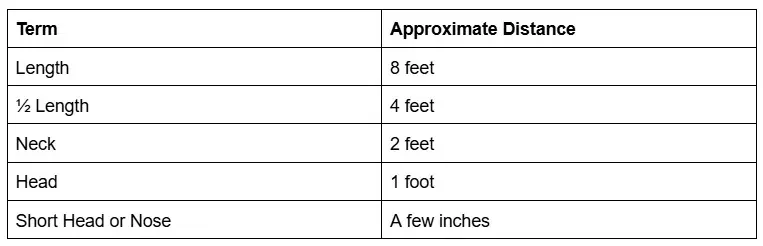
If horses finish in close proximity to each other, here are the even smaller units used.
For a better understanding of how a length is used in horse racing, it is often converted into time to compare horses' performances across races. A general rule of thumb is that a length is approximately 0.2-0.25 seconds in flat racing, which is a time-based approximation used in race replays or performance analytics.
Lengths in Horse Racing
Understanding what a “length” is adds depth to how you experience horse racing. Whether you're a casual fan, a serious handicapper, or just getting into the sport, knowing the lingo helps you interpret race outcomes more clearly and accurately.
So the next time you hear that a horse won “by 3 lengths,” you'll know that means it finished roughly 24 feet ahead of the next competitor. The length measurement is a way to better understand how horses performed, even if you did not watch the race live.
If you are interested in learning more about horse racing, then Racing TV is the place to be, as we have the best horse racing tips and guides available.
Copyright 2026 Racing TV - All Rights Reserved.
Please bet responsibly
Copyright 2026. All rights reserved